


A small marketing team has a calendar calling for eight blog posts a month. The writer wants a usable first draft, the editor wants accurate claims and a recognizable voice, and the SEO lead wants articles that answer the right searches. Each person can evaluate the same AI-generated draft and reach a different verdict.
The disagreement usually starts before generation. A team struggling with keyword selection needs a different tool from an agency spending too long rewriting client copy. A publisher with approved briefs but a slow CMS handoff has another problem entirely.
The right AI blog generator depends on the publishing bottleneck, not which platform produces the most polished demonstration. In a survey of 879 marketers, AI-assisted marketers published 42% more content per month than marketers who didn't use AI, according to Ahrefs. More output can help, but only when reviewers can maintain accuracy and usefulness.
The options below fall into distinct workflow groups:
- First-draft assistance for teams that already have research and editorial direction.
- SEO research-first platforms for teams that need help selecting topics and shaping coverage.
- Bulk publishing tools for publishers managing repeatable production.
- Marketing suites for teams coordinating brand messaging across channels.
These are workflow recommendations, not a ranking based on hands-on benchmark scores. Each platform needs to earn its place through the work it removes and the review effort it leaves behind.
Table of Contents
1. Outrank

Workflow fit: SEO-led production with CMS publishing.
Outrank suits a team that wants fewer handoffs between keyword research, article generation, image creation, and publishing. Its free AI blog generator offers an entry point into a broader platform built around automated content creation and management.
The platform combines keyword research, content customization, long-form drafting, and on-brand image generation. Publishing connections include WordPress, Webflow, and Notion, making it relevant when moving approved copy into a destination takes too much manual work.
Where the integrated workflow helps
Say an agency manages educational blogs for ecommerce brands. Researchers prepare topics, writers draft articles, designers create supporting visuals, and account managers coordinate publication. Outrank is worth evaluating when consolidating those stages would remove repetitive transfers.
- Brand customization: Reusable guidance can reduce repeated instructions about tone, audience, and positioning.
- Collaboration: Multi-user access can support shared production rather than isolated writer accounts.
- Automation: Publishing connections and API integrations can reduce manual handling after approval.
The trade-off is that an integrated workflow still needs separate editorial gates. A generated image isn't evidence, an SEO-oriented draft isn't original expertise, and a connected CMS shouldn't turn generation into automatic approval.
A useful trial should follow an article through the entire process, including image review and CMS formatting. Editors should check whether headings, links, captions, and metadata survive the transfer correctly. Outrank is the stronger fit when production coordination is the problem, rather than when a specialist writer needs help revising a paragraph.
2. Jasper
Workflow fit: A marketing suite for shared brand guidance.
A blog article, campaign email, and paid-social concept shouldn't describe the same product differently. Jasper addresses that coordination problem with brand voice, reusable business context, and marketing content workflows.
Its appeal is less about generating an isolated article and more about giving contributors common instructions. For agencies, that makes the quality of each client's context especially important. Approved examples, prohibited claims, terminology, and audience distinctions should be separated clearly.
Practical rule: Brand consistency and factual accuracy need different reviews. Copy can sound exactly right while making an unsupported claim.
Jasper deserves consideration when editors repeatedly fix positioning and tone across contributors. It's less compelling when a solo writer already maintains consistent messaging and only needs occasional outline assistance.
The review burden remains substantial for technical explanations, product comparisons, and performance claims. Brand controls shouldn't be treated as a substitute for subject-matter approval.
The distinction between assisted production and search performance also matters, a topic addressed in The Keyword's coverage of AI content growth and human articles in search results. A trial should measure whether Jasper reduces meaningful rewrites, not merely whether generated text resembles existing brand copy.
3. Writesonic
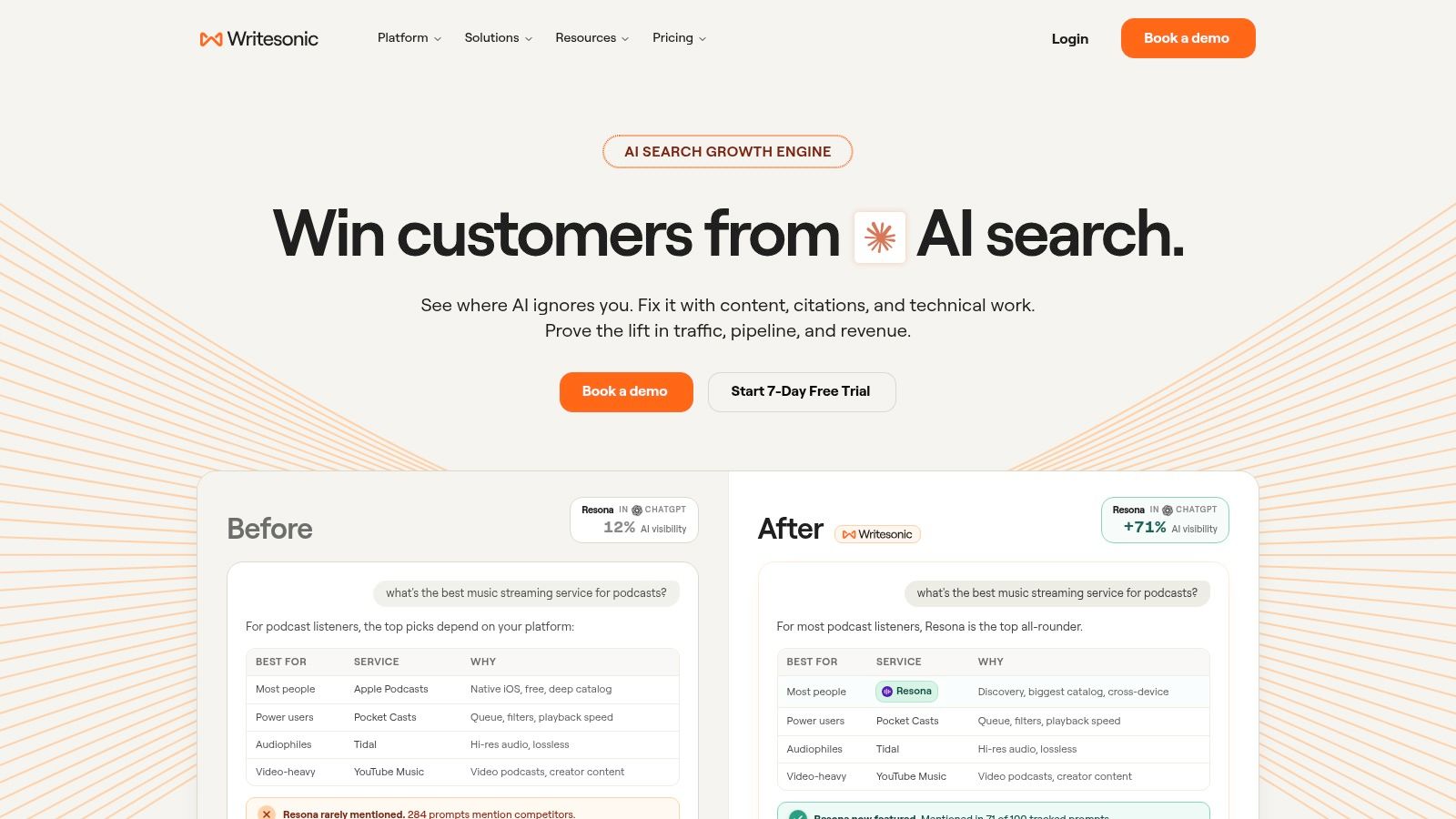
Workflow fit: Article production connected to search visibility work.
Writesonic combines article writing with content strategy, SEO, and AI-search-related capabilities. That combination suits teams that want content creation and visibility monitoring in the same working environment.
The buying question is whether those capabilities support the team's actual reporting needs. Brand styles, uploaded business information, article allowances, and visibility features vary by plan, so the evaluation should follow a specific publishing workflow rather than a feature count.
Keep generation and visibility separate
AI-search visibility isn't interchangeable with search rankings, referral traffic, or conversions. An analysis summarized by PPC Land found that only 36 of more than 1,200 analyzed brands appeared among the most-mentioned brands across every platform and month studied.
For a Writesonic trial, the team should distinguish:
- Production value: Whether approved references produce a more usable draft.
- Measurement value: Whether reporting separates mentions, citations, and website visits.
- Commercial value: Whether the content supports relevant customer actions.
The broader platform may be unnecessary for occasional drafting. Conversely, a team evaluating AI-search exposure should inspect reporting scope carefully rather than assume an AI blog generator can guarantee citation. Source checks and original evidence remain editorial responsibilities, even when writing and visibility tools share a dashboard.
4. Frase

Workflow fit: Research-first briefing and drafting.
An editor receives a topic such as retail media attribution, but the brief contains little beyond a keyword. Generating prose immediately would shift the unresolved research problem into the draft.
Frase is better considered at that earlier stage. Its SEO research, planning, drafting, and optimization capabilities can help a marketer move from a broad topic toward a defined article structure.
The useful output isn't necessarily the finished article. It may be an outline that identifies reader questions, distinguishes introductory material from advanced guidance, and gives a subject-matter expert something concrete to challenge.
- Best use: Developing research-backed briefs before committing to full generation.
- Main limitation: Existing search results can encourage familiar coverage rather than a distinctive argument.
- Review effort: Checking intent, validating sources, and adding material competitors haven't supplied.
A practical trial should compare the proposed outline with actual customer questions. If search results emphasize definitions but prospects struggle with implementation, the editor should change the structure.
Frase makes sense when briefing is slow or inconsistent. It's less useful when the team already has strong research and needs only sentence-level assistance. CMS publishing and monitoring capabilities should be evaluated against the selected plan, not assumed to be universal.
5. Surfer
Workflow fit: SEO-guided writing and content refreshes.
Surfer is most relevant when writers and SEO specialists need a shared editing environment. Its Content Editor brings search-based guidance into drafting, alongside AI generation, keyword research, topic maps, auditing, and tracking capabilities.
That makes it different from a blank-page writing assistant. The editor can work against an optimization brief while the SEO lead reviews coverage and relevance.
A content score is an editing input, not permission to publish.
The strongest use case is a team regularly creating or refreshing search-focused pages. An existing article may need a missing explanation, clearer terminology, or better alignment with the query rather than a complete rewrite.
Where editorial judgment matters
Recommendations should be rejected when they add irrelevant terminology, repeat explanations, or weaken readability. A media buyer searching for an implementation answer doesn't benefit from extra background added solely to satisfy a score.
The Keyword's guide to AI marketing engineering provides useful context for treating automation as part of a designed workflow rather than a standalone writing task.
During evaluation, editors should log which recommendations improve the article and which they override. Surfer fits an established SEO operation better than a casual blogger seeking uncomplicated drafting help, particularly when the team can interpret optimization guidance critically.
6. Rytr
Workflow fit: Lightweight first-draft and section assistance.
Not every publishing problem needs a larger content platform. Rytr is a writing assistant with templates for ideas, outlines, sections, and marketing copy, making it a reasonable candidate when research is already complete.
A writer might need alternative introductions for an approved article or a clearer explanation of a familiar concept. Those bounded tasks are easier to review than a complete article generated from a loose keyword.
- Useful task: Turning approved talking points into a section draft.
- Poor assignment: Producing an authoritative technical guide without source material.
- Operational consideration: Character-based allowances require different planning from article-based quotas.
Rytr's free tier provides a way to assess the interface and output before a paid commitment. The important test is whether its assistance reduces total editing work, not whether it fills a document quickly.
A section-by-section approach also has a cost. Writers must maintain continuity, remove repeated definitions, and ensure that separately generated passages support the same argument.
Rytr fits teams that already have a research process, an editor, and a publishing system. It shouldn't be selected to solve gaps in keyword strategy, source verification, or CMS automation. Its narrower role can be an advantage when those systems are already working well.
7. Koala AI (KoalaWriter)

Workflow fit: Repeatable long-form production and publishing.
KoalaWriter sits within Koala AI and targets SEO-oriented article production. Bulk writing, factual-data features, publishing integrations, and API access make it relevant to publishers with repeatable briefs.
Its publishing connections include WordPress, Shopify, Webflow, and Ghost. Those connections matter when an approved draft otherwise requires manual transfer into a separate environment.
Scale the brief before scaling generation
Bulk production works best when the editorial pattern is stable. A series of product-category explainers can share structural rules, but each article still needs accurate category-specific information and a distinct reader purpose.
Before expanding production, editors should examine a representative draft for:
- Source fidelity: Whether factual statements match their supporting material.
- Article distinction: Whether related posts answer different questions.
- Commercial accuracy: Whether product descriptions and recommendations remain defensible.
Access to current information doesn't eliminate the need to open the underlying sources. Affiliate articles also need particular care around recommendations and claims that imply product experience.
KoalaWriter is a stronger candidate when publishing volume and CMS handling are genuine constraints. Occasional bloggers may not need its automation. Teams evaluating it should test the complete handoff, including whether content can remain unpublished until an editor approves it.
8. Article Forge
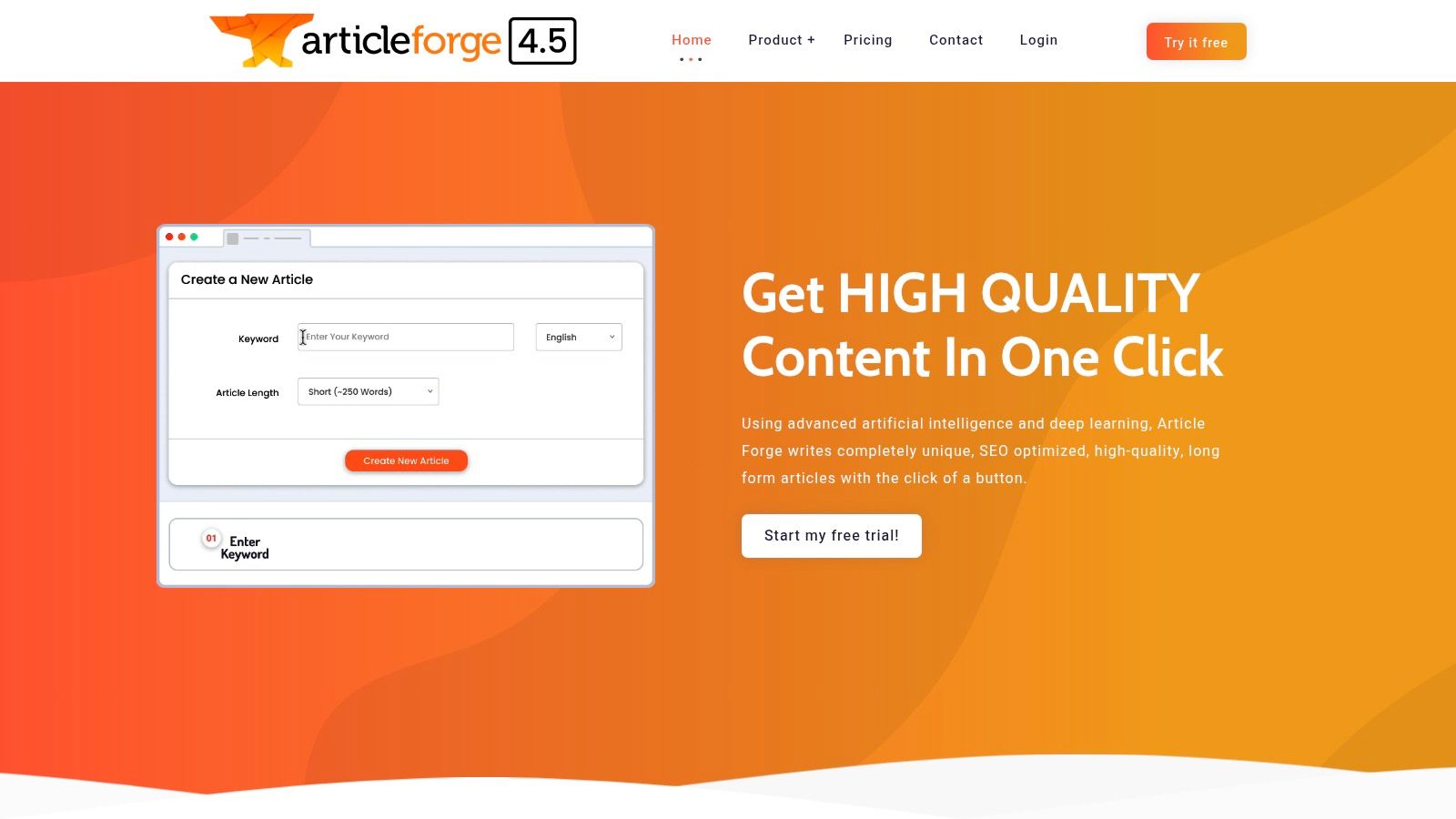
Workflow fit: Bulk first drafts from keywords or briefs.
Article Forge emphasizes automated long-form generation, bulk production, WordPress posting, and API access. It's a candidate for teams whose bottleneck is creating initial article material at volume.
That automation is also the central trade-off. A guided editorial process allows an editor to challenge an outline before prose accumulates. A more automated process requires the team to catch structural and factual problems after generation.
Publishing safeguard: An automated draft should enter a review queue, not bypass one.
The appropriate benchmark is approved articles, not generated words. A large output allowance offers little operational value if editors must reconstruct arguments, replace unsupported claims, and remove repetitive passages.
For a trial, reviewers should inspect a representative batch rather than selecting the strongest result. They should assess recurring errors as well as individual article quality, because repeated weaknesses become more expensive across a publishing program.
The Keyword's editorial standards offer a useful reference point for defining publication expectations separately from software capabilities.
Article Forge makes the most sense for structured, lower-risk content with clear review ownership. It's a weaker fit for original reporting, nuanced comparisons, or articles whose value depends on an expert's argument rather than a general explanation.
9. Anyword
Workflow fit: Blog writing within a campaign-copy program.
A marketing team may need an article, landing-page variants, and promotional copy built around the same audience problem. Anyword combines a Blog Wizard with brand settings, audience context, copy templates, and performance-related features.
Its appeal is strongest when blog production belongs to a broader messaging workflow. Teams can evaluate article framing alongside the language used to promote the content, rather than treating each asset as unrelated.
- Potential advantage: Shared audience and brand context across marketing assets.
- Important limitation: Performance predictions don't establish actual rankings, conversions, or reader trust.
- Required review: Claim accuracy, audience fit, and consistency between the article and its promotional copy.
A performance marketer should test whether suggested wording preserves the article's substance. A stronger promotional headline can become a liability if it promises a conclusion the article doesn't support.
The included plagiarism checker can contribute to review, but similarity checking doesn't verify factual accuracy or establish original expertise.
Anyword is worth considering when campaign messaging and blog drafting share owners. A blog-only team may find the surrounding capabilities unnecessary. The trial should compare useful editorial outcomes, including whether the draft needs less audience and positioning work, rather than treating a predicted score as a result.
10. NEURONwriter
Workflow fit: SEO analysis and AI assistance across multiple assignments.
NEURONwriter combines content planning, optimization, AI templates, and a long-form Content Designer. It's relevant to writers and smaller teams that need a structured workspace for search-focused assignments.
The practical buying issue is capacity. Project limits, document allowances, and AI-credit consumption can affect how comfortably the platform supports ongoing client or brand work.
Evaluate completed assignments, not available credits
Different features and model choices can consume resources differently. A useful trial should include the research, generation, revisions, and optimization required for a normal assignment rather than stopping after the initial draft.
Higher-tier integrations and collaboration features also deserve a workflow test. A team needing CMS or Google Search Console connections should confirm that the relevant tier includes the required access.
The editorial limitation is familiar but important: optimization guidance cannot supply missing expertise. If an article explains marketing attribution, a competent reviewer still needs to check distinctions between measurement approaches and reject oversimplified conclusions.
NEURONwriter makes sense when planning and optimization are recurring needs, not incidental extras. It's less suitable when the main challenge is coordinating broad marketing campaigns. The strongest trial outcome is a useful article produced with manageable editing and predictable resource consumption, not just a higher optimization score.
11. Scalenut

Workflow fit: Guided SEO planning through drafting and refinement.
Scalenut brings keyword planning, topic research, AI writing, and optimization into a connected workflow. That suits teams that want more guidance between choosing a subject and producing an editable draft.
It's especially relevant when topics arrive without a clear content plan. The platform can support the planning-to-drafting sequence, but the team still needs to decide which topics deserve investment and what original contribution each article will make.
- Best fit: An SEO-led program seeking a connected planning and writing environment.
- Possible overlap: Teams with established research and optimization tools may duplicate existing capabilities.
- Review burden: Source checks, intent validation, original examples, and factual approval remain necessary.
The evaluation should begin with an unresolved topic, not a polished brief prepared elsewhere. Otherwise, the team won't learn whether Scalenut's planning capabilities solve the problem that justified considering it.
Publishing and team features depend on the plan, while promotional offers can complicate comparisons. A buying decision should follow the ongoing workflow and applicable terms rather than the prominence of a discount.
Scalenut is a sensible shortlist candidate when research, planning, and drafting all need improvement. It's less compelling when only a narrow writing task needs assistance and the rest of the publishing system already works.
How the 10 AI blog generators differ on pricing, free options, and best-fit use
The useful split is the job each tool removes and the review work it leaves behind. List prices and trial windows change often enough that they should not drive the decision; use them to check budget fit after workflow fit is clear.
| Item | Pricing and free options | Best-fit use | Review still required |
|---|---|---|---|
| Outrank | Free blog generator; paid automation for SEO publishing | Automated SEO content creation and publishing | Brief quality, internal links, factual checks, CMS approval |
| Jasper | Free trial; plans aimed at marketing teams | Brand-consistent blogs and campaign work | Voice rules, claims, examples, channel fit |
| Writesonic | Plan-led access across writing and visibility tooling | Combining article writing with SEO and AI-search tools | Source support, search intent, duplicate-angle checks |
| Frase | Free trial; research and drafting in one workflow | SEO research that feeds an editable draft | Brief accuracy, evidence, original examples |
| Surfer | Plan-led access for search-focused work | SEO teams creating or refreshing content | SERP assumptions, factual accuracy, refresh priorities |
| Rytr | Free plan; budget-friendly assistance | Bounded short-form writing tasks | Tone, facts, expansion into publishable structure |
| Koala AI (KoalaWriter) | Limited free allowance; paid plans for scale | Publishers producing SEO articles at scale | Thin sections, sources, product claims, templates |
| Article Forge | Free trial; automation-first production | High-volume automated article production | Originality, factual review, indexing risk, approval gates |
| Anyword | Free trial; marketing-oriented plans | Blogs plus campaign copy under one voice | Message consistency, claims, audience fit |
| NEURONwriter | Free trial; writing with SEO optimization | Writers and small teams pairing drafts with on-page guidance | Keyword targeting, references, final edit |
| Scalenut | Plan-led access from planning through drafting | SEO-led planning, creation, and optimization | Topic selection, intent, contribution beyond the brief |
Grouped by workflow: Outrank, KoalaWriter, and Article Forge suit repeatable production. Frase, Surfer, NEURONwriter, and Scalenut lead with research or optimization. Jasper and Anyword fit brand and campaign systems. Writesonic sits between drafting and visibility work, while Rytr stays useful when the assignment is narrow and the edit is light.
Choosing an AI Blog Generator You Can Actually Trust in Production
Start with the bottleneck, then select the category. Teams struggling with brand consistency should compare marketing suites such as Jasper and Anyword. Teams missing research and briefing structure should examine Frase, Surfer, NEURONwriter, or Scalenut.
Publishers managing repetitive production should assess Outrank, KoalaWriter, and Article Forge against their approval and CMS requirements. Rytr deserves consideration for bounded writing assistance, while Writesonic fits teams evaluating connected writing and visibility workflows.
Shortlist a small group and run the same real brief through each platform. The brief should include the audience, purpose, approved references, required claims, prohibited claims, brand examples, and intended conversion action.
Measure the work that remains
Record preparation time, generation time, editing time, and CMS cleanup separately. A platform that generates prose quickly may still require extensive source replacement or structural revision.
Editorial review is a normal production requirement, not an exceptional precaution. An eMarketer summary of Ahrefs survey findings reports that 89% of marketers manually check AI output.
Compare candidates using concrete outcomes:
- Factual accuracy: Unsupported statements, incorrect interpretations, and invented references.
- Citation completeness: Whether factual claims can be traced to appropriate sources.
- Brand fit: Changes needed to positioning, terminology, and tone.
- Editorial usefulness: Whether the article answers the reader's actual problem.
- Publishing readiness: Formatting, links, images, metadata, and approval handling.
The trial should also expose risk. Repurposing approved material can follow a lighter process than health, finance, law, safety, or current-events coverage. Sensitive topics need qualified reviewers and a clear decision about where generation stops.
Keep accountability outside the generator
Assign a named editorial owner before expanding production. Retain source material, preserve revision history, define disclosure expectations, and establish a correction process.
Human expertise should enter before publication, not appear as a cosmetic final pass. Original interviews, proprietary analysis, and informed examples give an article something beyond a summary of existing pages.
The winning AI blog generator is the tool that reduces total effort while meeting publication standards. A confident draft, an optimization score, and a direct publishing connection aren't substitutes for that result.
Before committing to a paid plan, the content lead should run a representative brief through shortlisted tools and compare the edited outputs with the team's current process. For continued coverage of search changes, AI tools, and marketing operations, subscribe to The Keyword's free Wednesday newsletter and use those updates to revisit the workflow as platform capabilities change.