


Three proposals land on the same desk. Same brief, same sitemap, same launch date, and three prices that don't line up. One studio promises a custom build in six weeks, one quotes a discovery phase before it will name a number, and one has already sent a moodboard. Nothing in those documents tells the buyer which team will ship.
That's the failure of most lists of the best web development companies. They rank on awards, logos and review averages, which measure how a firm presents itself rather than how it handles a stalled migration or a checkout bug two weeks before Black Friday. The market context makes the choice consequential: the global web-development services market was valued at approximately $80.6 billion in 2025 and is forecast to reach $134.17 billion by 2031, an estimated compound annual growth rate of 8.87%, according to industry statistics compiled by Gaugius. Buyers aren't purchasing a design file, they're committing to an engineering relationship.
The firms below are matched to project types instead of podium positions: a product MVP, a publishing platform, an e-commerce build, a WordPress brochure site. Each entry says what the firm does well, where it creates risk, and the questions worth asking before signature. Read the entry that matches the brief and skip the rest.
Table of Contents
- 1. Refact
- 2. 10up
- 3. thoughtbot
- 4. Netguru
- 5. Digital Silk
- 6. Lounge Lizard
- 7. 3 Media Web
- 8. Coalition Technologies
- How the seven firms differ by best-fit project, platform focus, and pricing transparency
- Turn the Shortlist Into a Scoped Brief Before You Compare Quotes
1. Refact
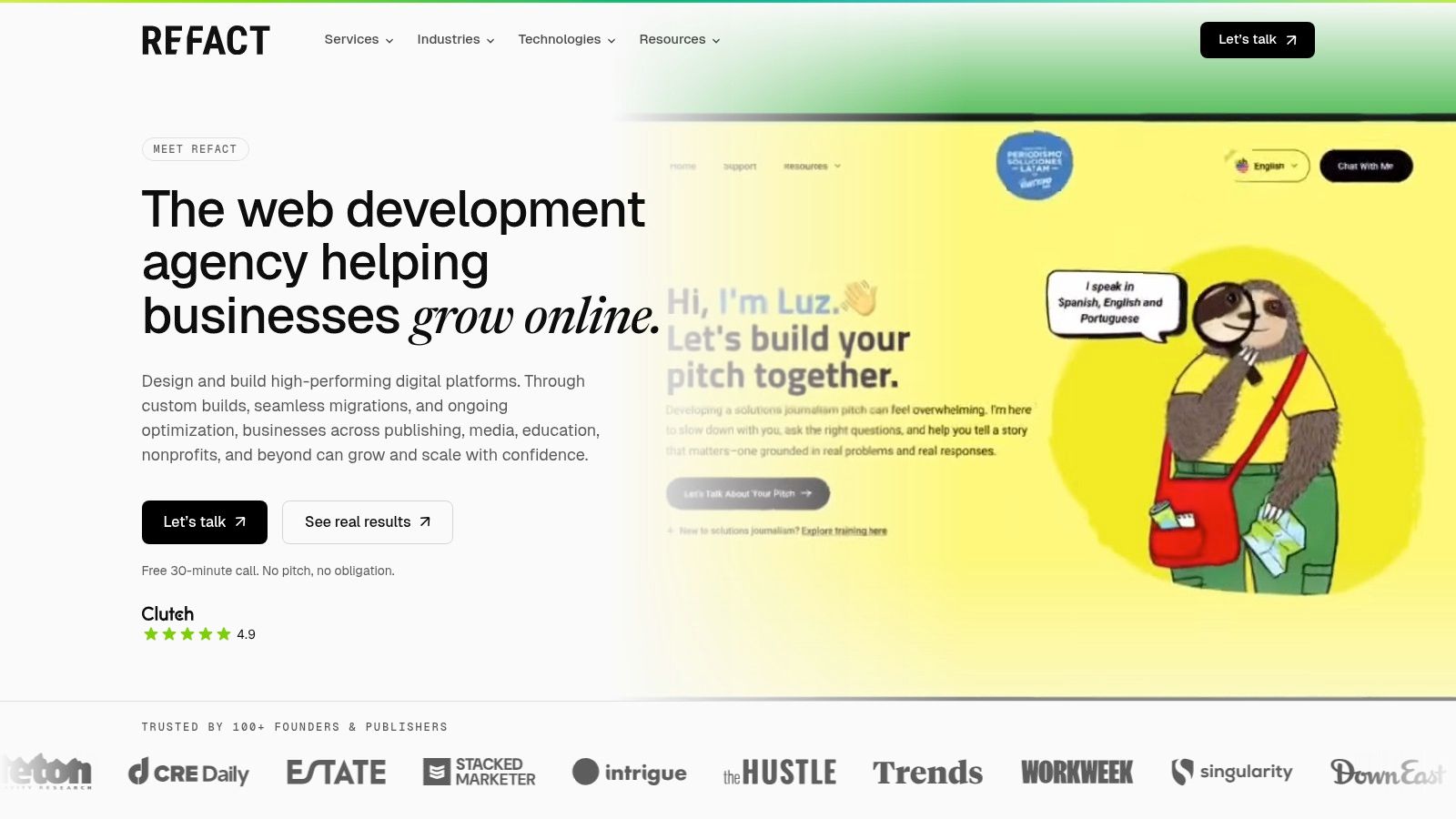
A founder with a clear market thesis but no engineering team needs a studio that can shape the product before estimating delivery. Refact is built around that gap. Product strategy, design and full-stack engineering sit under one roof, and the engagement starts with deciding what to build and why before anyone writes code. That sequencing matters because stalled builds often trace back to an unresolved product decision nobody owned.
The focus is SaaS applications, MVPs, WordPress and e-commerce platforms, publishing systems, AI-powered tools and platform migrations. Client work spans media and publishing, education, e-commerce, consulting, membership organizations, nonprofits, hospitality and real estate. Its published web development technologies list includes React, Next.js, TypeScript, Node.js, Python, PHP, WordPress, Shopify, WooCommerce, Strapi, Sanity, PostgreSQL, AWS, Stripe, Vercel and Tailwind CSS.
Why the stack choice is a procurement question
Widely adopted frameworks are easier to hire against and easier to hand over later. Stack Overflow's 2025 developer survey, summarized in a web development market share analysis, reports development use of React by 44.7% of respondents and Next.js by 20.8%. A studio working in that ecosystem reduces the risk of depending on scarce specialists. The practical trade-off is that familiar tools do not guarantee clean architecture. Ask how components, content models and integrations will be documented so the next team can take over without rebuilding the basics.
Practical rule: the strongest signal in a studio's history isn't launch count, it's relationship length. That is the metric worth probing with any vendor.
Where it fits, and where it doesn't
Refact suits a founder or subject-matter expert who needs a thinking partner, not a pair of hands. It also fits migrations where content, CRM and email data have to move without breaking the business. That kind of work rewards a team willing to map dependencies before moving records. It's a poor fit for a buyer who already has finished designs and wants cheap implementation hours. In that case, a narrower development shop may be the better commercial match.
- Ask who owns product decisions: confirm the named person on the client side who signs off on scope changes.
- Ask what happens after launch: get the maintenance, monitoring and iteration terms in writing before the build starts.
- Ask for a comparable migration: same CMS, same data volume, same integrations, not a portfolio highlight reel.
2. 10up
A newsroom needs editorial workflows that survive a breaking story. A university needs thousands of pages governed by dozens of editors. Both need caching that holds when a piece goes viral. 10up builds for that world, and its agency site positions the firm around websites and tools for content creators rather than general business builds.
That focus changes the procurement question. You are buying an editorial system, not just a design delivery. The scope covers strategy, design, engineering, cloud infrastructure, SEO, analytics and revenue optimization. For a media group that would otherwise stitch together a design agency, a hosting specialist and an ad-ops consultant, that breadth removes handoffs, and handoffs are where publishing projects lose months. The distributed team model also helps organizations with editorial staff in several time zones.
Two trade-offs deserve attention. First, this is a firm for substantial engagements. A five-page brochure site doesn't need enterprise publishing architecture and shouldn't pay for it. Second, public evidence is thin in the usual places. Pricing isn't listed, and third-party review coverage is limited. That calls for reference calls with comparable publishers rather than reliance on aggregated scores.
Accessibility is the criterion most publishing buyers forget to test, and it recurs after launch every time an editor publishes a new template. In a large accessibility study cited by Be Accessible's web accessibility statistics, 94.8% of home pages had at least one detectable accessibility failure. That makes conformance a contract item, not a launch-week check.
A high Lighthouse score doesn't prove a site is usable with a screen reader. Ask which WCAG version and conformance level are written into the contract, and who fixes defects after a CMS update.
3. thoughtbot
A product whose requirements will change is a different purchase from a website whose requirements are known. thoughtbot works on the first kind. Its product and engineering services combine strategy, design and development, with senior practitioners across Ruby on Rails, Hotwire, React and Elixir, and the option to embed specialists alongside an in-house team rather than take the whole project.
The Rails and Hotwire lineage is worth understanding before signing. It favors server-rendered applications with modest JavaScript, which tends to produce small teams, fast iteration and low operational overhead. For an MVP where the data model is still moving, that's an advantage. For a product that needs a heavy client-side interface or a large React component library shared with an existing frontend, the fit needs a direct conversation about boundaries.
The dependency is client-side ownership. This model works when someone on the buyer's side can answer product questions daily, prioritize ruthlessly and say no to features. Without that person, iterative development becomes expensive drift, and no agency process fixes it. Pricing isn't published, so budget clarity comes from a scoped proposal, not a rate card.
There's also a scale question. The enterprise end of this industry looks nothing like a product studio: Umbrex's profile of Accenture records fiscal-2024 revenue of $64.9 billion for the year ended August 31, 2024, with a footprint covering more than 120 countries. A buyer running a global rollout across dozens of business units needs that kind of delivery capacity. A buyer validating one product doesn't, and shouldn't pay for it.
Ask thoughtbot for a recent project where the scope changed mid-build, and how the change was priced.
4. Netguru
Netguru publishes indicative cost ranges, which is rarer than it should be and useful for early budget planning. Its web application development services page lists $30,000 to $80,000 for an MVP, $80,000 to $250,000 for a business-grade app, and $250,000 to $600,000+ for complex or enterprise work. Treat those as orientation, not a quote. Integration count, compliance requirements and architecture move the number more than page count ever does.
The service scope runs discovery, UX/UI, development, quality assurance, API integrations, cloud infrastructure and post-launch support, with Rails, React, Node.js and Python experience. That combination suits products that have to talk to other systems: a payments provider, an ERP, a warehouse platform, an identity service. Integration work is where estimates break, so the useful question isn't "what does an app cost" but "what does each integration cost, and who owns the API contract when the third party changes it."
Sizing the category helps set expectations. Market Research Future's web development report values retail and e-commerce web development at $18.59 billion in 2024, one of the largest demand segments in the sector. Commerce-adjacent product work is a mature specialty, which means buyers can and should demand comparable references rather than accept general capability claims.
Two cautions. The published ranges make clear this isn't a route to a budget website. And client-rating or project-count claims on a service page are marketing until validated, so ask for two references at similar scope and one where the project went badly. Teams evaluating specialist partners for AI features can cross-check shortlists against this guide to the best AI agencies in the UK before committing to a single vendor.
5. Digital Silk
Digital Silk sells the whole chain: website strategy, design, development and ongoing optimization, across WordPress, Shopify, Magento and headless setups. For a brand that wants one accountable partner from positioning through launch, that's coherent. For a team holding finished Figma files and needing implementation only, it's paying for layers it won't use.
The commercial terms are visible on Clutch, which lists a $10,000+ minimum project size and an $100 to $149 hourly range, alongside reviews that praise communication, project organization and design quality. Some reviews also report project delays. That mix is normal for full-service agencies and it points to the exact clause to negotiate: milestone definitions, acceptance criteria and an escalation path with names attached.
Watch for: "launch support" means different things in different contracts. Get the number of post-launch weeks, the response time for a production defect, and the rate for work outside scope written down.
Performance is the other place where full-service shops vary widely, and it's measurable before signing. Open the agency's live client sites on a mid-range Android phone over a throttled connection, not on office wifi, and time the largest content element. Then ask whether they run real-user monitoring after launch and who reads the reports. Controlled lab scores are easy to produce and don't reflect the devices a brand's customers use.
Practical checks before the deposit:
- Confirm the platform decision: ask why Shopify rather than headless, or Magento rather than WooCommerce, in terms of the client's operations.
- Separate design from build: request the deliverables list for each phase so a stalled design stage doesn't consume engineering budget.
- Baseline the current site first: a free SEO audit gives the redesign a documented starting point for rankings, indexation and page performance.
6. Lounge Lizard
Lounge Lizard is a WordPress-first custom shop, and its website development services center on custom themes, reusable content components, integrations for forms, CRM and analytics, performance work and interactive functionality. It also builds on Shopify and Adobe Commerce, and offers design-only engagements as well as combined design and development.
The reusable-component approach is the part worth testing. A well-built component library means an editor can assemble a new landing page without a developer, which is the difference between a site marketing can use and a site marketing has to queue behind. Ask for a staging login and try to build a page nobody designed. If it requires a ticket, the library isn't finished.
Client feedback on Clutch frequently praises creativity, communication and project leadership, which fits an agency whose strength is brand expression plus a manageable CMS. The trade-offs are scope and transparency. Pricing isn't published and depends heavily on platform and functionality, and a broad agency engagement rarely makes sense for a tightly scoped coding task.
Migration hygiene is where brochure-site projects lose traffic, and it belongs in the statement of work rather than a verbal assurance:
- Redirect mapping: every legacy URL mapped to its destination, tested on staging before DNS moves.
- Analytics continuity: confirm events, goals and consent tooling are rebuilt, not assumed.
- Accessibility and support: name the conformance level and the post-launch owner in writing.
Buyers pairing a rebuild with paid acquisition should also decide early who owns landing-page production, since that ongoing workload often outlasts the build itself. This comparison of Facebook ads agencies is a useful reference for scoping that side of the work.
7. 3 Media Web
Founded in 2001 as a development shop before expanding into design and digital marketing, 3 Media Web has a positioning that suits a specific buyer: a B2B organization that wants a WordPress site connected to broader marketing objectives rather than a standalone artifact. Development is part of the agency's stated history, not an add-on service, and that usually shows in how it handles integrations and editorial workflows.
The fit is strongest for companies with a long sales cycle, where the site's job is qualifying inquiries, supporting sales conversations and feeding a CRM. In that context, an agency that also thinks about digital experience optimization can align a redesign with pipeline goals instead of aesthetic ones. A specialist CMS agency is often more relevant here than a general software vendor.
The gap in public information is specificity. Reviewed material is less clear about current pricing and the technical stack, so the burden shifts to the buyer's questions.
Ask for three examples that match your industry, CMS, integration list and page count. Agency-wide experience doesn't transfer automatically to a large manufacturing catalog with ERP-driven pricing.
The other clause to pin down is bundling. When an agency offers development, maintenance and marketing together, the proposal should state which pieces are optional, what each costs separately, and what happens to site support if the marketing retainer ends. Buyers who can't answer that discover it at renewal, when their negotiating position is weakest.
8. Coalition Technologies
Coalition Technologies covers custom website development, CMS work, e-commerce, web apps, speed optimization, security, maintenance and third-party integrations, with SEO and digital marketing alongside. Its web design and development services span WordPress, Shopify and WooCommerce, which makes it a candidate when the build and the acquisition channel need to be coordinated by one provider.
That coordination is the actual product here. A store migration handled by a team that also runs search marketing tends to produce better redirect discipline, cleaner category structure and fewer arguments about who broke organic traffic. The trade-off is obvious: a buyer who only wants a development vendor is buying an agency shaped for something else, and the account team's attention will follow the recurring revenue.
Demand is not the constraint in this category. The Business Research Company's web development market report valued the global market at $71.01 billion in 2025 and projects it to reach $102.28 billion by 2030. Plenty of firms can build a store. Fewer can prove they've handled the specific complications yours has.
So the verification work is narrow and concrete:
- Comparable case studies: same platform, similar SKU count, same payment and shipping integrations, with named contacts.
- Deliverables, not adjectives: ask what "speed optimization" includes, which templates are touched and how results are measured after release.
- Pricing clarity: the development service page doesn't list pricing, so request a line-item scope separating build, maintenance and marketing.
Agency-level review volume tells a buyer about consistency across many projects. It says nothing about the team assigned to yours, which is the only team that matters.
How the seven firms differ by best-fit project, platform focus, and pricing transparency
| Item | Best For | Core Platforms | Public Pricing Signal |
|---|---|---|---|
| Refact | Non-technical founders building or evolving online products | React, Next.js, Node.js, WordPress, Shopify | No public pricing listed |
| 10up | Publishers and large organizations with complex content platforms | WordPress and open-source technologies | No public pricing listed |
| thoughtbot | Teams building or improving product-focused web applications | Ruby on Rails, Hotwire, React, Elixir | No public project pricing listed |
| Netguru | Custom applications with integrations, cloud needs, or ongoing support | Rails, React, Node.js, Python | Indicative ranges: $30,000–$80,000 for an MVP; $80,000–$250,000 for a business-grade app; $250,000–$600,000+ for complex work |
| Digital Silk | Full-service website strategy, design, and development | WordPress, Shopify, Magento, headless platforms | Clutch lists a $10,000+ minimum and $100–$149 hourly rate |
| Lounge Lizard | Custom CMS websites, branding, and e-commerce | WordPress, Shopify, Adobe Commerce | Pricing not published |
| 3 Media Web | B2B organizations seeking a CMS website tied to marketing goals | WordPress-oriented; current stack details are limited | Current pricing not specified publicly |
| Coalition Technologies | E-commerce and business websites coordinated with SEO or marketing | WordPress, Shopify, WooCommerce | Pricing not clearly listed on its development page |
Turn the Shortlist Into a Scoped Brief Before You Compare Quotes
Write one page before contacting anyone. It should state the project type (publishing platform, product MVP, e-commerce build, WordPress brochure site), the platform and whether that's a decision or a preference, every integration with its owner, the launch date and what makes it immovable, and a budget range rather than a single number. Add the two or three constraints that would sink the project, such as a legacy URL structure that must be preserved or a procurement security review. Send that identical page to three shortlisted firms.
Comparable proposals are the only useful proposals. When each vendor answers the same brief, differences in milestones, assumptions and exclusions become visible in a way that three unrelated pitch decks never are.
Score four things across the responses:
- Milestones and acceptance: what has to be true for each payment, and who signs off.
- Post-launch ownership: response times for security and accessibility defects, and what the retainer covers.
- References at similar scope: same platform, same complexity, ideally a project that hit trouble and how it was handled.
- The named team: who does the work, their allocation, and what happens if the lead leaves.
Post-launch ownership deserves more weight than most buyers give it, because legal exposure doesn't stop at launch. According to ADA Title III litigation tracking, 3,117 website-accessibility lawsuits were filed in U.S. federal court in 2025, up 27% from 2024, and website cases represented 36% of all federal ADA Title III filings. A vendor who won't name a remediation owner is transferring that risk to the buyer.
Also settle control before signature: the code repository, cloud accounts, analytics property, design files, deployment pipeline and third-party licenses. Ask what happens when the retainer ends. The answers reveal whether the relationship is a partnership or a dependency, and a more expensive firm that reduces replatforming and lock-in can cost less over several years.
For the market context behind these decisions, The Keyword covers digital marketing for over 200,000 marketers across a news site, newsletter and social channels, and its free weekly newsletter arrives Friday at 7am with what moved in ads, search and social. Subscribe before the next platform change forces a rebuild, and send that one-page brief to three firms this week.