


A Facebook ads agency is rarely hired just to press buttons in Ads Manager. The key decision is who owns the account, the conversion data, and the judgement calls when Meta's automation spends money faster than a client can check it. Fees matter, but incentives matter more. An agency paid to increase spend, judged on platform ROAS and holding the only clean export of results can look successful while margin falls. The sections below separate price from alignment, and reporting from proof.
Table of Contents
Facebook Ads Agency Pricing Models Compared
On $10,000 of monthly Meta spend, a 10% to 20% management fee comes to $1,000 to $2,000 before any setup charge, creative fee or monthly minimum. Two quotes at the same spend can still cover different creative volume, tracking work, reporting depth and seniority, so compare the model and scope rather than the headline number alone.
| Pricing model | How it is charged | Typical range | Best fit | Main risk |
|---|---|---|---|---|
| Monthly retainer | Fixed fee each month | Scales with creative volume, markets in scope and reporting depth rather than spend | Steady budgets with ongoing testing | Fee continues when results stall |
| Percentage of ad spend | 10% to 20% of monthly media spend | $1,000 to $2,000 on $10,000 spend, often with a monthly minimum | Accounts where budget grows over time | Rewards higher spend rather than profit |
| Project fee | One-off audit, rebuild or tracking setup | Priced against named deliverables inside a fixed scope | Diagnosing an existing account | Ends with no ongoing optimization |
| Performance-linked fee | Bonus or fee tied to an agreed result | Bonus sized in the proposal against one named metric | Clients with reliable conversion tracking | Result definitions can be gamed |
| Hybrid | Base retainer plus a performance or percentage component | Base priced like a retainer, variable element defined in the proposal | Growth brands wanting shared risk | Complex contracts that need careful auditing |
The $10,000 example
Say a brand spends $10,000 a month on Meta. Under a 10% to 20% model, the management fee is $1,000 to $2,000 before any setup charge, creative fee or monthly minimum. That can be reasonable when the workload grows with spend, for example more product lines, markets and tests.
The incentive is the problem. If spend rises to $20,000, the fee doubles even if the extra budget goes into the same campaigns and profit gets worse. A fixed retainer avoids that automatic tax on growth, though it keeps billing during a flat month. A hybrid can balance both sides, provided the variable part is tied to margin or qualified outcomes rather than raw spend or platform-reported conversions, which can count sales that would have happened without the ads. Of the models above, a pure percentage of spend is the one I would challenge first in negotiation.
Charges buyers often miss
- Setup and audit fees: Account rebuilds, Pixel and Conversions API work, and catalog fixes may sit outside the monthly fee.
- Monthly minimums: A percentage model can still carry a floor, so small budgets may pay an effective rate well above the quoted percentage.
- Creative scope: Concepts, copy, design, video editing and landing page advice are not interchangeable, so the proposal should name quantities and revision limits.
- Markets and complexity: Multiple countries, languages, feeds and approval layers change the workload and should be priced explicitly in the proposal.
Practical rule: A cheaper fee is not cheaper if it excludes the creative testing and measurement work that determines whether media spend works.
Before accepting any model, a buyer should get written answers to three questions. What exactly does the fee cover each month? Who owns the ad account, Pixel, audiences and finished creative? What happens to the fee, notice period and handover if results fall for two consecutive months? An agency that answers those cleanly on paper will usually run the account the same way.
What a Facebook Ads Agency Manages Day to Day
The weekly work is less glamorous than agency case studies suggest. A competent Facebook ads agency maintains account structure, makes audience and placement decisions, produces and tests creative, paces budgets, checks bidding, keeps tracking healthy, and explains what changed. Reporting and client calls sit on top of that operating rhythm, not instead of it.

The scope is now cross-platform. Meta's 2025 Form 10-K reported $196.175 billion in advertising revenue, up 22% from $160.633 billion in 2024, from products across Facebook, Instagram, Messenger and third-party mobile applications. A contract should therefore name the placements and properties in scope instead of assuming "Facebook" covers everything.
The pit crew division of labour
Think of the agency as a pit crew. The client owns the car, the offer and the destination. The agency handles tyres, fuel, timing and quick adjustments, then flags when the car itself, such as pricing, stock or a weak landing page, is the limiting factor. That distinction prevents every sales problem from being mislabelled as a targeting problem.
Day to day, that means checking spend pacing and frequency, pausing fatigued ads, moving budget between ad sets, and reviewing comments or policy rejections. Weekly work usually includes new creative variants, audience exclusions, and a test readout. Monthly work should reset priorities by product, margin and inventory rather than raising budgets.
One month for a skincare brand
Say a skincare brand sells cleansers, serums and bundles. In week one, the agency separates prospecting from retargeting and gives each product line its own naming convention and budget guardrails. In week two, it tests five angles, such as ingredient proof, routine simplicity, before and after routines where policy allows, founder explanation and bundle value.
In week three, weak angles are stopped and winning hooks are rebuilt in new formats for Reels, Feed and Stories. Checking competitors in the Facebook Ad Library guide helps the team spot repeated claims and formats before briefing the next batch. In week four, results are reported by product line, not blended together, so a profitable serum doesn't hide a loss-making bundle.
The client should receive direct account access, a testing log, an event and naming document, and monthly decision notes. Each note should state what changed, why it changed, what evidence supported it and who approved it. Without that trail, performance meetings become opinions about a dashboard nobody can audit later.
Benchmarks Agencies Should Report Against
A single CTR or CPC target hides the economics. Traffic, lead generation and purchase campaigns buy different actions, so each objective needs its own baseline, its own prior history and a line into the business result after the click.
| Campaign objective | Average CTR | Average CPC | Cost per lead | Conversion rate |
|---|---|---|---|---|
| Lead generation | 2.59% | $1.92 | $27.66 | 7.72% |
WordStream's 2025 Facebook Ads benchmarks analyzed more than 1,000 campaigns and found lead-generation campaigns averaging about 2.59% CTR, $1.92 CPC, $27.66 cost per lead and 7.72% conversion rate; the same source puts traffic campaigns at a 1.71% average CTR and gives no traffic CPC or conversion rate. Treat these as U.S. directional markers, then judge the account against its own auction, offer price and history.
Why expensive clicks can be the better buy
A training company can often buy traffic clicks cheaply and still see few consultation requests. A lead campaign usually pays more per click because Meta is optimizing toward a scarcer action, but that higher CPC is rational if those leads book calls and close. The commercial question is cost per won opportunity, not cost per visit.
The reverse failure is common too. Curiosity-led creative can lift CTR while sending the sales team unqualified enquiries, which is why lead reporting must continue into the CRM with stages for contacted, qualified, booked and won. If the agency is paid as a share of spend, ask which metric would make it recommend a budget cut; cheap volume can look tidy while revenue stalls.
A reporting procedure that prevents blended nonsense
- Separate by objective: Traffic, lead generation, app and sales campaigns get separate rows, budgets and targets.
- Set local baselines: Industry, country, audience size and offer price change the auction, so external benchmarks sit beside account history.
- Audit lead quality: The CRM owner marks qualified and disqualified leads before the agency optimizes toward volume.
- Annotate disruptions: Offer changes, price rises, tracking repairs and creative resets get noted beside the month they happened.
- Use a rolling comparison: Each objective is judged against its own prior three months, not a blended account average.
Compare each objective against its own row and its own history, never against a blended account average.
That rule exposes trade-offs early. CPC can rise while qualified cost falls, or CTR can improve while sales quality deteriorates; a useful monthly report states which outcome matters commercially, what evidence supports it and what budget decision follows.
Knowlify Handles Ad Creative From Concept to Final Cut
Creative volume is often the constraint behind stalled Meta performance. Targeting and bidding can't rescue a small set of tired ads, especially when a team needs fresh hooks for prospecting, retargeting and different placements. Knowlify addresses that production bottleneck as a done-for-you AI video advertising agency for B2B and B2C companies running paid social.

Knowlify creates AI UGC ads, Pixar-style character animation ads and AI commercials, handling concepts, scripts, production, editing and sound. Every finished ad receives a human quality check. That combination matters because speed without review produces off-brand claims, awkward delivery or formats that don't suit the placement.
How the workflow runs
The engagement starts with a kickoff call covering the product, audience, goals and brand assets. Knowlify then sends creative direction for approval before production begins, so the client signs off on hooks and angles upfront. Finished ads arrive in batches on a recurring schedule, and campaign results feed back into the next round of concepts.
Do the operational arithmetic. A team that needs five new concepts in a testing cycle, each adapted for prospecting and retargeting, quickly builds a briefing, scripting and editing queue. A batch production model keeps that queue moving without the client hiring separate writers, creators and editors for every test.
Where it fits
Clients can buy creative production only, or combine it with end-to-end Facebook and Instagram campaign management.
Media spend is separate. Clients retain their ad accounts and every finished ad, with responsibilities and pricing agreed in the proposal. That ownership point makes Knowlify easier to compare with a traditional Meta ads agency, because the buyer can separate creative supply from account control.
Ownership matters beyond convenience. When the client holds the ad account, audience and performance history stay with the business if the relationship ends, and the buyer can audit targeting, delivery and spend directly in Ads Manager rather than relying on an agency report. Examples and booking details are on the Knowlify site. The fit is strongest when creative testing speed is the bottleneck and the buyer wants finished video ads without surrendering the ad account.
Profit Math for Ecommerce Accounts
ROAS can look respectable while an ecommerce account loses money. The missing inputs are gross profit, returns, shipping, discounting and the cost of buying impressions. Agencies should forecast contribution, not celebrate a platform ratio in isolation.
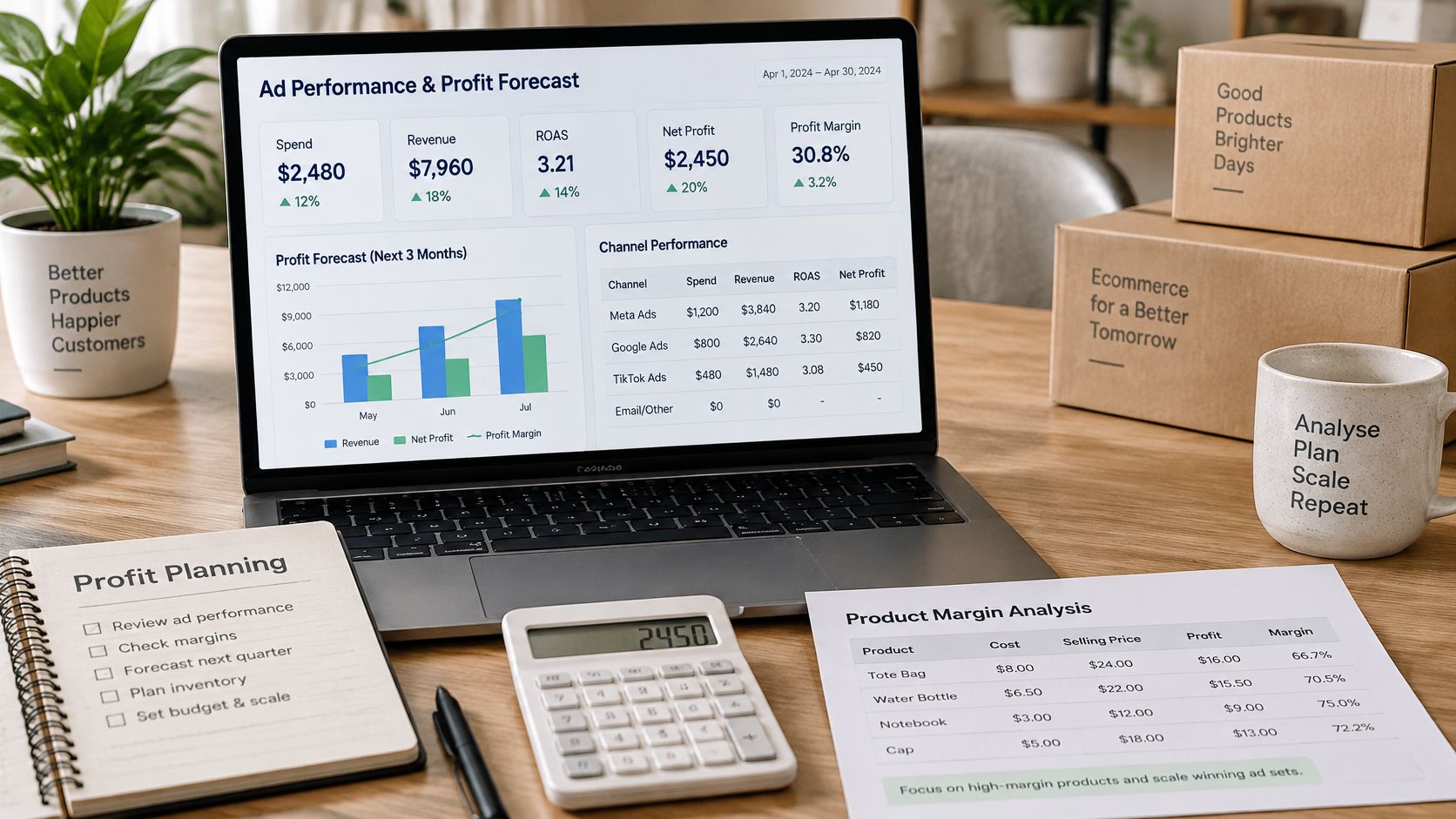
A useful reference point comes from Triple Whale's Facebook Ads benchmarks, which reported median CPM of $15.06, CTR of 2.39%, conversion rate of 1.53%, CPA of $38.99 and ROAS of 1.88. The same dataset reported a 13.24% year-over-year CPM increase across industries.
Worked example
Take a hypothetical $10,000 monthly budget. At a $15.06 CPM, it buys about 664,000 impressions. At a 2.39% CTR, those impressions produce roughly 15,870 clicks. At a 1.53% conversion rate, the result is about 243 orders, giving an implied CPA near $41.
Now add margin. If gross profit is $30 per order after product and fulfilment costs, 243 orders produce about $7,290 in gross profit against $10,000 of ad spend. The account loses roughly $2,710 before agency fees, despite performance sitting close to recognizable ecommerce benchmarks. That is the calculation a media plan should show before launch.
The short video below is useful as a prompt to check the dashboard against the underlying order economics, rather than treating any single platform metric as profit.
What to model every month
- Auction pressure: CPM by audience, placement and season.
- Creative efficiency: CTR and thumb-stop performance by concept, not just by ad set.
- Site efficiency: Click-to-purchase rate by landing page, device and product.
- Order economics: Average order value, gross profit, returns and discount rate.
- Fatigue risk: Frequency, declining CTR and rising CPA by creative age.
Strong creative can offset some CPM pressure by lifting CTR and reducing implied CPC. It can't fix a product whose margin is below acquisition cost. The dataset uses ecommerce medians, so it suits scenario planning and spotting abnormal accounts. It doesn't guarantee a target for every country, category or price point.
Who Owns the Data and Measurement Pipeline
Better tracking does not automatically produce better decisions.
Pixel and Conversions API installation is only a checklist until someone owns the operating model. An agency can send more events to Meta, increase reported conversions and still make budget decisions worse if those events duplicate, misclassify or claim sales that would have happened anyway.
The contract should name who controls event definitions, consent records, deduplication between browser and server events, CRM outcome imports, attribution windows and the business source of truth. It should also state who keeps the documentation and admin access when the engagement ends. An agency that holds the only event map leaves the client renting its own measurement system.
That dependency gets expensive fast. When the engagement ends and nobody can explain which trigger fires the purchase event, every unexplained conversion spike becomes guesswork instead of diagnosis.
Policy and access limits
Meta's advertising standards and policies place responsibility on advertisers and require service providers to protect advertising data, restrict its use and apply it only to authorized campaign measurement. Raw measurement data is often narrowed further by partner terms and consent status, so some fields reach the advertiser only in aggregated or masked form.
Those limits make promises of perfect attribution a warning sign. Modeled conversions, view-through conversions and CRM-confirmed revenue answer different questions, and a strong agency reconciles them openly instead of presenting the largest number as the truth. Teams comparing approaches can use the marketing attribution software guide to clarify which system should record spend, sessions, orders and qualified pipeline.
A four-step ownership routine
- Name the source of truth: For ecommerce, that's usually the order system after cancellations and returns. For leads, it's the CRM stage history.
- Document the event map: Each event needs a trigger, parameters, consent rule, deduplication method and an owner.
- Reconcile weekly: Compare Meta conversions against orders or qualified leads, investigate gaps and log tracking changes before judging performance.
- Test incrementally: Run one holdout or geo test each quarter to estimate the conversions Meta caused rather than the ones it merely observed.
Score an agency on implementation quality, data access, auditability and privacy compliance alongside dashboard results. Then ask the exposing question: when should spend be cut despite strong Meta ROAS? A credible answer mentions blended margin, stocked-out products, weak incrementality or CRM outcomes. An evasive answer points back to the platform dashboard, which conveniently protects an agency fee tied to spend.
What Automation Changes and What Stays Human
Advantage+ and AI bidding don't remove the need for judgement. They move judgement upstream, into the offer, creative system, margin targets, data inputs and rules for stopping spend. The agency's value is no longer manual bid tweaks. It's designing the conditions under which automation is allowed to act.
| Decision | Often automated by Meta | Kept human by a strong agency |
|---|---|---|
| Audience | Advantage+ audience expansion | Customer definition, exclusions and offer fit |
| Placements | Automatic placement selection | Creative formats per placement and brand-safety limits |
| Bidding | AI bidding toward a target | Target CPA or margin input and bid-cap decisions |
| Creative | Dynamic creative variations | Concept strategy, testing plan and fatigue calls |
| Budget | Distribution across ad sets | Risk limits, approval thresholds and pacing rules |
| Measurement | Platform-attributed conversions | Holdout design, incrementality tests and source of truth |
Adoption claims need careful handling. 2025 Facebook Ads statistics reporting claims 82% of Facebook advertisers used Meta's Advantage+ suite and AI-bidding campaigns reported 27% higher ROAS than manual campaigns. Those figures aren't a neutral randomized benchmark and may reflect selection effects, because stronger advertisers may adopt automation earlier.
The incrementality test
The useful question isn't whether automation found conversions. It's whether it created incremental profit. A campaign can harvest branded demand, existing customers or people already close to purchase, then report attractive ROAS while total business revenue barely moves.
An agency should therefore propose holdouts, geo tests or controlled budget changes before claiming automation caused growth. It should also disclose when automated audience and placement choices reduce transparency. When performance falls, less visibility makes diagnosis harder, so the testing log and business data become more important.
Governance a client can request
- Permitted data sources: Which CRM, product, margin and customer lists may be used, and for what purpose.
- Change thresholds: Budget moves above an agreed percentage or daily cap need named approval.
- Experiment plan: Holdout or geo-test design, duration, success metric and decision rule agreed before launch.
- Profit switch: The point at which platform ROAS stops being the target and contribution margin takes over.
- Override rights: Who can pause automation, tighten exclusions or restore manual controls, and how quickly.
Understanding how delivery systems reward relevance and predicted action also helps, and the Meta algorithm guide gives useful background for those discussions.
An in-house team can often run Meta without an agency when one product line has a stable budget, staff can build tests and read holdouts, and the CRM already reports lead quality. An agency becomes more valuable when the account needs cross-product testing, senior creative production or an outside audit of automated spend. Two closing questions reveal the boundary: which decisions are automated, and who can override them?
Confirm an Agency Is the Right Fit Before You Sign
Discovery calls reward confidence. A scoring sheet rewards evidence. Rate every candidate on the criteria below, weighting data ownership and reporting highest because they decide whether results can still be trusted after the contract ends. Then turn the strongest candidate's promises into a short pilot with named metrics and exit terms.
| Criterion | Strong sign | Red flag |
|---|---|---|
| Reporting | Results split by objective, with CRM lead quality | One blended ROAS figure for all campaigns |
| Data ownership | Client owns the ad account, pixel and CRM exports | Agency holds the only copy of conversion data |
| Fee clarity | Fee, minimums and spend-based charges in writing | Fee changes based on unspecified performance terms |
| Testing plan | Named tests, holdouts and a creative calendar | Only promises to optimize |
| Exit terms | Short notice period with data handover | Long lock-in with no transition plan |
| Automation disclosure | States which decisions are automated and can be overridden | Credits all gains to proprietary AI |
Five steps before signing
- Request a sample report: Ask for a redacted monthly report from an account of similar size and check that objectives, spend, business outcomes and next actions are separated, with lead quality shown against cost per result rather than buried in a summary.
- Inspect ownership terms: Request the event map, access list and a written clause covering the ad account, Pixel, audiences, creative files and exports, then confirm the clause still applies after termination.
- Review live creative: Check current client ads where permission allows, looking for varied hooks and formats rather than one template repeated. The Keyword's Learn guides on the Facebook Ads Library and the Meta algorithm give useful background for that review.
- Agree a pilot: Set a 60 to 90 day pilot with one primary metric, a holdout plan, spending limits and a named reviewer on each side.
- Write the exit first: Cover notice, final reporting, data handover, access transfer and removal of agency users before the first invoice.
A pilot is the cheapest credible test because it converts a sales promise into observed working habits. It shows whether reports arrive with decisions, whether tracking problems are surfaced early, and whether the agency recommends restraint when evidence is weak. It also exposes fee incentives. An agency paid on a percentage of spend reveals its instincts when the pilot's limits are fixed in writing.
Sign only when the agency scores well on data ownership and reporting, explains its fee incentives without evasion, and accepts a pilot with clear exit terms. Walk away when access is restricted, results are blended, or every gain is attributed to a proprietary system the client can't inspect.