


Social media customer service means answering questions, complaints and requests sent through public posts, comments, mentions and direct messages, and resolving them where the audience can see the outcome. In 2023, 51% of consumers said the most memorable action a brand can take on social media is responding to them. That result comes from Sprout Social's survey of more than 1,800 consumers in the United States and United Kingdom.
That visibility changes the work. A reply isn't a private ticket update, it's a public promise that other customers judge before they buy. The public-to-private handoff therefore needs its own rules, owners and measures, not a habit of sending every complaint to direct messages.
Table of Contents
What Social Media Customer Service Is and Why It Pays Off
Social media customer service means answering questions, complaints and requests that customers send through public posts, comments, mentions and direct messages, and resolving them where the audience can see. It's closer to a shop with its counter on a busy high street than to a phone queue. Passers-by hear the question, the answer and the tone, including people who never planned to contact the brand.
Three Differences From Phone and Email
- The conversation is public: Followers, search visitors and future buyers can read the exchange long after the case closes.
- Customers expect minutes, not days: A post feels like real-time contact, so silence reads as refusal rather than backlog.
- Social is often the first attempt: Many customers post before trying email or phone, especially when other channels have already failed them.
The commercial case is direct. In the 2016 study conducted by Twitter and Applied Marketing Science, researchers surveyed 3,139 users across industries including airlines and pizza-delivery companies. Customers who received responses were willing to spend 3% to 20% more, were 30% more likely to recommend the brand and were 44% more likely to share their experience online or offline.
That's why cost per contact is the wrong lens on its own. A useful public answer can reassure dozens of readers with the same delivery, sizing or setup problem, while an ignored complaint gives those readers a reason to choose a competitor. The cost shows up later as repeat contacts, returns and lost sales, none of which appear in a simple inbox report.
A public reply serves two audiences at once, the customer who asked and every prospect deciding whether the brand can be trusted.
A practical starting check takes less than an hour. Search mentions, tags and comments from the last 30 days and count how many contain a service request, a complaint or a pre-purchase question. That count, not follower growth, is the true size of the social service workload.
Response Time Targets Customers Expect
These practitioner targets aren't platform rules. Teams should tune them to volume, staffing and risk, then publish only what named cover can deliver.
| Message type | Target first reply | Why this target |
|---|---|---|
| Public complaint on a main post | Within 1 hour | Visible to every follower; delay reads as neglect |
| Direct message about an order or account | Within 1 hour in staffed hours | Personal issues carry the highest urgency expectation |
| Product or pre-purchase question in comments | Within 4 hours | Buyers may leave before a reply arrives |
| General feedback or praise | Within 24 hours | Lower urgency; a short acknowledgment is enough |
| Safety, health or legal claim | Same hour, human review | Automated replies carry legal and reputational risk |
| Outside staffed hours (any type) | Automated acknowledgment with a stated reply window | Sets expectations and states the next staffed window |
The expectation gap isn't new. The Ovum and Coleman Parkes survey commissioned by Amdocs, reported in 2014, found that 50% of consumers preferred social media to telephone support, while approximately three-quarters of those who used it received no response or no resolution. In the same survey, 52% expected a response within 30 minutes, while only 24% of companies said they could respond that quickly.
Making a Target Operable
A one-hour promise needs a rota owner for every staffed hour, a backup for breaks and a rule for who takes the queue during meetings. Without that cover, the table is decoration. Outside staffed hours, an automated acknowledgment should state when a person will reply, not claim that the team will respond shortly.
During a launch, outage or delivery failure, a pinned status update reduces duplicate posts and shows the queue isn't abandoned. Safety, health and legal claims break the normal order. The target there is human pickup within the hour, not a fast template that could admit fault or give unsafe advice.
The immediate task is narrow. Choose the three most common message types, assign one target and one owner to each, and write them into the workflow before the next review.
How to Run a Social Response Workflow, Step by Step
A unified inbox is the operating centre, because service requests hide in ad comments, story replies and tagged posts.
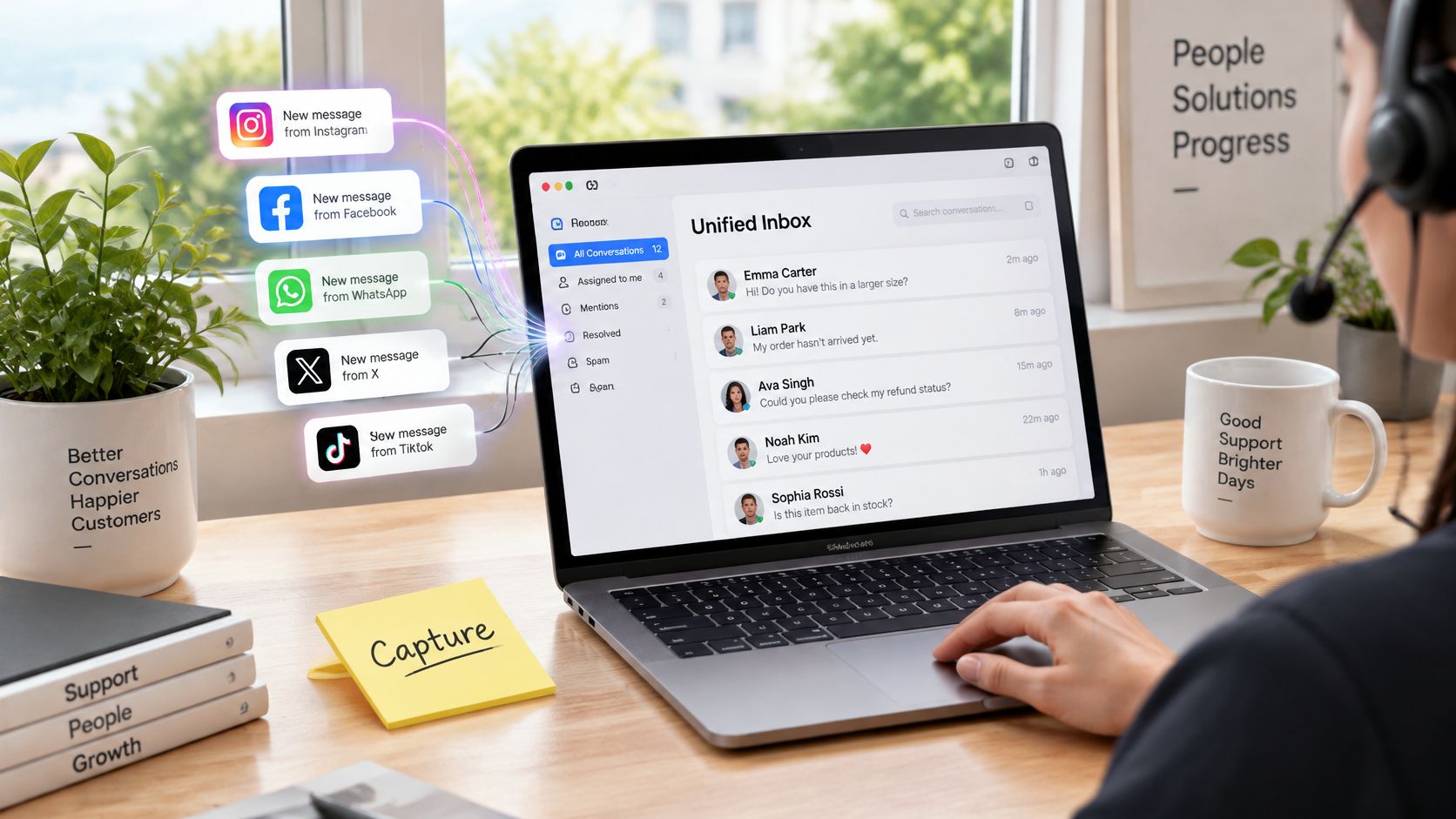
- Capture everything in one inbox: Pull mentions, comments, tags and direct messages from every platform into one queue with search and assignment. The common slip is checking only the main account feed and missing complaints under ads or older posts.
- Triage by risk, not arrival order: Tag severity, privacy risk, sentiment and owner as soon as an item lands, so the response clock matches the target for that message type. Tagging by volume pushes easy praise ahead of a safety claim.
- Acknowledge publicly, without personal details: Name the problem in one short reply and state the next step. A generic template that doesn't mention the issue tells observers the brand didn't read the post.
- Move private only for a reason: Request a direct message when order, payment, account or personal details are needed. Moving every case to direct messages by default hides helpful answers and can look evasive.
- Resolve and log the full case: Record the outcome in the CRM with the original post ID, the private thread link, the owner and any refund or replacement reference. Logging only the outcome leaves the next agent unable to rebuild the conversation.
- Close the public loop: Return to the original thread with a short confirmation that doesn't repeat private details. Leaving the thread open makes a solved case look abandoned to everyone who finds it later.
- Follow up before closing: Check after 24 to 48 hours that the fix worked, then close the case. Closing when a replacement is dispatched, rather than when it arrives, creates avoidable repeat contacts.
The sequence matters because each step creates evidence for the next one. Capture proves nothing was missed, triage sets the deadline, and logging makes the private work auditable. Tools such as Meta Business Suite, Sprout Social, Hootsuite or a helpdesk with social integrations can support the queue, but the workflow has to define ownership first.
A short walkthrough shows how the media below fits the same operating rhythm, from first sighting to confirmed closure.
A Broken Parcel, Handled Cleanly
Say a customer posts a photo of a parcel that arrived broken. The public reply confirms the team is checking the order and will send a direct message shortly, the private message asks only for the order number, and the fix is a replacement. The public thread then gets a brief resolved note, and the follow-up confirms the replacement arrived intact.
Platform Rules That Change Your Playbook
Platform messaging settings change often, so teams should confirm current access before promising a channel. The table maps where service really happens and where a private case can go.
| Platform | Where service happens | Public reply | Private channel | Watch-out |
|---|---|---|---|---|
| Facebook Pages | Post comments, Messenger | Yes, comments under the post | Messenger | Confirm the page's current messaging settings |
| Comments, story replies, DMs | Yes, comments and story replies | Instagram DMs | DM availability can vary by account type | |
| X | Replies, mentions, DMs | Yes, threaded replies | DMs, if the account accepts them | Complaints can spread through quote posts outside your account |
| TikTok | Comments, DMs where enabled | Yes, comments | DMs where enabled | DM access depends on eligibility and region |
| YouTube | Video comments, community posts | Yes, comments | Often none; route to a support form or email | Comment volume is hard to moderate at scale |
| WhatsApp Business | Customer chats | Not public | Private chat by default | Public-style acknowledgment does not apply |
What Changes Operationally
Facebook and Instagram mix public comments and story replies with Messenger and Instagram direct messages, so one inbox must hold both sides of the same case. On X, threaded replies become a public record and quote posts can carry a complaint far beyond the brand account. Speed matters there, but so does not arguing in public.
TikTok service usually starts in comments under fast-moving videos, including ads, while direct message access can be restricted. YouTube comments are public and difficult to moderate at scale, so many teams acknowledge there and route account-specific cases to a support form or email. WhatsApp Business is private by default, which suits order updates but gives no public proof that the brand responded.
Planning rule: Never build a handoff around a private channel until someone has tested that the account can receive and reply to those messages.
Readers who follow platform changes across channels will know The Keyword focuses on news across Paid Search, SEO, Social Media, Connected TV, E-commerce and Retail Media. The practical task is to assign every active platform to one model, public-first, private-first or private-only, and record the fallback when direct messages aren't available.
How Exerta Can Help
Faster automation does not automatically mean better service. A fast reply that is generic, off-brand or unable to escalate fails the customer worse than a slower, accurate one. Exerta is a software platform that deploys AI agents to manage customer engagement and recover revenue across social and web channels.
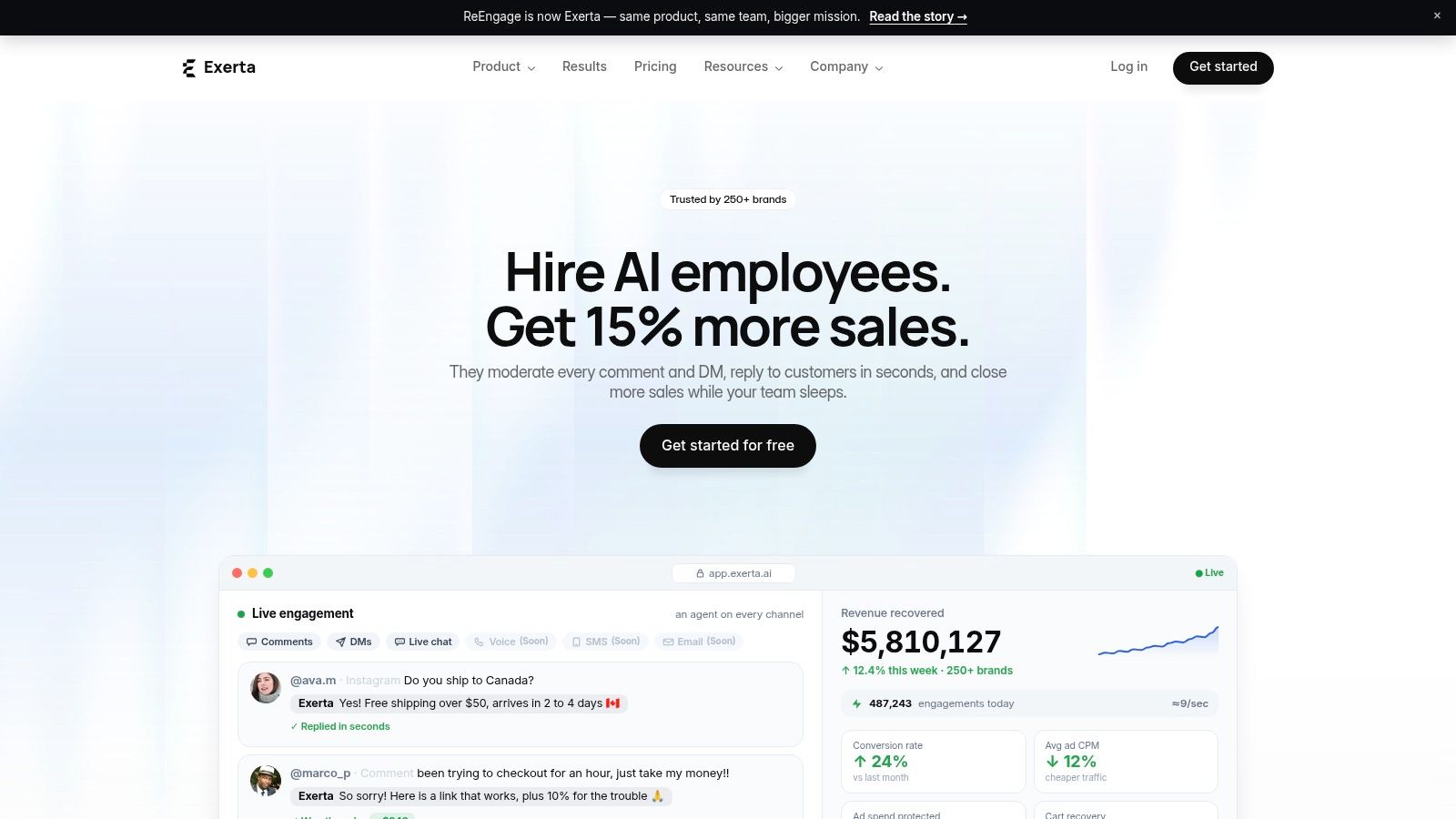
For social media customer service, the relevant work is specific. Exerta automates replies to comments and direct messages in a brand-consistent voice, moderates harmful content, hides spam and scams, and can include links, prices, offers and discount handling. Every action is logged and attributed, which gives teams an audit trail instead of a black box. That logging matters for the handoff question: a team can review which cases stayed in public threads and which moved to private messages, then check whether the agent followed the rules it was given.
Where It Fits Best
- DTC and ecommerce brands: Product questions, buyer-intent comments and checkout follow-ups can be answered consistently across Facebook, Instagram, TikTok and website chat.
- Telehealth and lead generation teams: Configurable escalation and approval workflows help keep routine engagement moving while sensitive cases go to people.
- Coaches, info businesses and agencies: No-code setup through Meta Business Manager, brand training controls and multi-branch workflows reduce repetitive inbox work without a developer project.
The strongest use case is a busy ad account where unanswered comments cost sales and toxic comments waste spend. Teams working through managing Facebook comments will recognise the pattern, because moderation, replies and sales recovery sit in the same thread. Real-time dashboards, mobile access and Shopify attribution connect replies and hidden comments to interaction volume and recovered revenue.
Vendor-reported adoption and revenue figures deserve the same treatment as any other benchmark: test them against the team's own baseline before committing. I would judge a platform like this on resolution quality, escalation accuracy and attributed orders rather than response speed alone, and I would sample logged conversations to confirm the handoffs match what a trained agent would have done. SMS, email and voice are on the roadmap, so current buying decisions should rest on the live social and web chat coverage.
Handoff Rules Shown Through a Delayed Order Case
Say a customer posts publicly that a delivery is three weeks late and includes part of a street address. An instant instruction to check direct messages may protect privacy, but observers see no acknowledgment and the address fragment stays unaddressed. The better sequence starts in public, carefully.
The public reply apologises for the delay, confirms the order is being checked and invites a direct message, without repeating the address. Privately, the agent verifies the full address, order number and carrier record, then arranges a reshipment or refund. The public thread closes with a neutral line confirming the delivery issue has been resolved directly with the customer.
That expectation is measurable. In a 2025 consumer survey reported by Sprout Social, 51% of people who contact brands publicly expected a public acknowledgment before being moved into a private conversation. A silent move can therefore look like avoidance, even when the private reply is fast.
Decision Rules for the Handoff
- Keep it public when others benefit: Shipping disruption notices, known outages, sizing guidance and general policy answers help readers beyond the original poster.
- Move private for personal data: Order and payment details, account access, addresses, health or safety information and legal threats should not be handled in a thread.
- Move private for emotional escalation: A distressed or angry customer needs room, verification and discretion, not an audience.
- Check the channel first: The platform map must confirm the private route is open for that account, with a form or email fallback if it isn't.
- Document both sides: Link the public thread and private conversation in the CRM, with owner, deadline, resolution and closure status.
The fastest private reply isn't always the best outcome. Visible acknowledgment reassures the audience while the sensitive work happens elsewhere.
The reader task is to write a one-page handoff rule from these bullets and test it against the last ten complaints. Any case the rule can't classify needs a named exception, such as legal review, before the next spike arrives.
Measuring Social Service Beyond Response Time
Response time alone misleads. A team can hit every message in ten minutes with templates that never fix anything, then watch customers return angrier. Social media customer service needs measures for visibility, resolution and effort.
| Metric | What it measures | What it reveals |
|---|---|---|
| First response time | Time from customer message to first reply | Speed against expectation, not quality |
| Acknowledgment time | Time to first public acknowledgment of a complaint | Whether the wider audience sees a response |
| Private resolution time | Time from DM move to documented fix | Real service speed on the issue |
| Public closure rate | Share of moved cases returned to the public thread with a closing reply | Whether the outcome is visible to others |
| Repeat contact rate | Share of customers who write again on the same issue within a set window, such as 7 days | Whether the fix held |
| Escalation rate | Share of cases passed to a specialist or manager | Accuracy of triage rules |
| Customer effort | Customer rating of how hard it was to get the issue fixed | Friction that speed metrics hide |
Read metrics in pairs. Fast acknowledgment with a high repeat-contact rate means the public reply reassures people but the underlying fix is shallow. A high escalation rate suggests triage sends too little, too late to specialists, while a low public closure rate means prospects never see evidence that problems get solved.
Customer effort can be captured with one post-resolution question asking how hard it was to get the issue fixed, scored on a five-point scale. Low-volume teams don't need the full table at first. Private resolution time, repeat contact rate and customer effort give a workable baseline over 30 days.
Attribution discipline helps here too, and teams comparing measurement approaches can use the marketing attribution software guide to keep channel outcomes separate from service outcomes. Choose three metrics, baseline them this month and review movement monthly before setting tougher targets.
Where AI Helps and Where People Must Decide
The workable model is hybrid. AI protects availability and triage, while people keep empathy, discretion and accountability for consequential decisions.
The Emplifi Social Pulse Consumer Brand Survey 2025 found that one-third of surveyed users expected a response to a social tag or DM within one hour, while two-thirds preferred a human response even when AI could be faster. Slow replies and thin out-of-hours cover are also common sources of negative social service experiences, so the trade-off is real: automation can hold the line at 2 a.m., but it cannot own judgement.
Safe to Automate
- FAQs and opening hours: Stable facts with approved wording and clear source data.
- Order-status checks: Only when the answer comes from verified order or carrier data.
- Routing and first acknowledgment: Tagging, queue assignment and an honest statement of when a person will reply, including whether the case stays public or moves private.
Keep Under Human Review
- Money and account decisions: Refunds, account enforcement and billing disputes need authority and records.
- High-risk allegations: Discrimination, health, safety and legal claims require trained judgment.
- Vulnerable or escalated customers: Distress, bereavement, financial hardship and intense anger should be handled by a person with room to act.
Treat every AI-touched case as a handoff candidate with three checks: whether intent was classified correctly, whether the conversation moved private only when account details were needed, and whether a route back to public closure was preserved. Failure recovery has to be scheduled, not improvised. Sample AI replies weekly for invented policy answers, keep the full conversation at handoff so customers do not repeat themselves, and define compensation when automation causes an error. Customers should know when they are talking to AI and see a clear route to a person.
Platform automation is moving quickly, including Meta's Business AI for customer purchase inquiries. That raises the value of clear boundaries. Measure successful resolution, escalation quality, correction rate and customer effort, because a fast wrong answer damages trust twice.
Set Up Your Playbook Before You Scale
Start with a one-page playbook. It should contain response targets, handoff rules, the platform map, three chosen KPIs and AI boundaries, plus the name of the queue owner for each staffed period. Anything longer won't be used during a busy shift.
Pilot that playbook for two weeks on the platform generating the most service messages. Review every moved case at the end of each week, checking whether the public acknowledgment, private resolution and public closure all happened. Then compare the pilot with the 30-day baseline and change one rule at a time, so the cause of any improvement or dip is clear.
Assign one person to check platform rule updates monthly. The Keyword delivers across a news website, newsletter and social media channels, which makes routine monitoring easier to build into that review, alongside practical resources such as local listings management guidance for keeping customer-facing details consistent. Social media customer service is a public promise, and the fastest reply only counts when the outcome is visible to the people who were watching.
Put the playbook into practice this week. Audit the last 30 days of mentions, write the three response targets and one-page handoff rule, and pilot them on the busiest platform. Then subscribe to The Keyword for practitioner coverage of platform changes, AI tools and social updates that affect the inbox before the next complaint arrives.