







Google’s AI Overviews have gone from a feature bolted onto search results to the place most queries now land. The share of Google searches that return an AI Overview has climbed from 15% a year ago to 43%, according to a new Similarweb analysis of the generative search landscape, first reported by TechCrunch. The jump marks the point where AI answers stopped being an add-on and became the default way people meet Google.
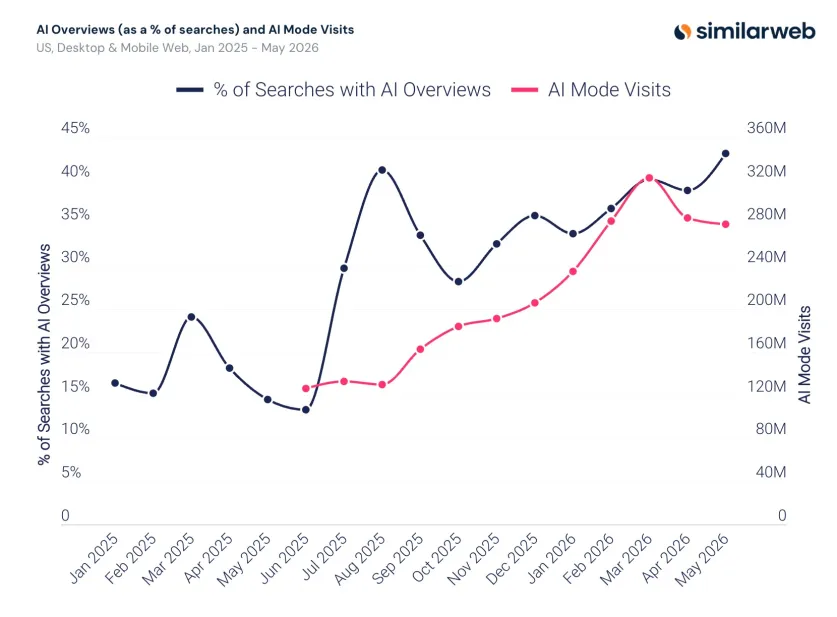
The same report tracks a parallel rise in Google’s more conversational surface. Visits to AI Mode, where users can keep asking follow-up questions after an initial AI answer, more than doubled from 126 million in June 2025 to 279 million by May 2026. Read together, the two numbers describe a funnel Google now controls end to end: it drops searchers into an AI Overview, then pulls them deeper into AI Mode, without either step sending them to an outside website.
Google Becomes The Destination
For most of its history Google worked as a gateway, a list of blue links people clicked to reach the answer somewhere else. Similarweb’s data shows that model giving way to one where Google is the answer.
The average length of a Google search has grown over the past year, which suggests people are dropping short keyword queries in favor of longer, conversational ones written for an AI to interpret. When the answer sits inside the results page, the time a user would once have spent on a publisher’s site stays with Google instead.
Publishers Absorb The Cost
The websites Google indexes are on the losing side of the trade. AI Overviews summarize what those sites publish, and the citations that accompany the summaries rarely convert into visits. The number of AI responses that carry a citation has risen more than fivefold in the past year, by Similarweb’s count, but a citation is not a click. The strain has been sharpest for news publishers, some of whom The Keyword reported this month are weighing whether to block Google’s crawler rather than feed answers that return no traffic.
The picture is not uniformly bleak, though, and that nuance matters for anyone measuring AI search. On ChatGPT, U.S. desktop referrals to webpages more than doubled after a May 7 update, rising from 25% in March 2026 to nearly 60% by the end of May. The improvement suggests that when an AI product surfaces prominent links, people do click them, and that not every AI answer is equally hostile to the open web.

What Marketers Should Read Into It
The headline figure is a floor, not a ceiling. If 43% of searches already trigger an AI Overview, planning for AI-mediated discovery is no longer a hedge against a future state. It describes the present. The practical response follows the same logic that governs AI Mode’s organic recommendations: earn the citations by being the source an AI answer wants to quote. Only 6.8% of U.S. ChatGPT desktop queries included a citation as of May 2026, a reminder that AI search is still early and its plumbing is still being built. The direction, though, is set.
Recap
How often do Google’s AI Overviews now appear in search?

According to Similarweb, AI Overviews appeared in 43% of Google searches in 2026, up from 15% a year earlier.
How is AI search changing the way people use Google?
Google increasingly answers queries directly through AI Overviews and its conversational AI Mode, so users stay on Google longer and type longer, more natural queries rather than clicking through to websites.
What does the shift mean for publishers?
Publishers are losing referral traffic because AI citations often do not lead to clicks, though ChatGPT’s referral rate to webpages improved after a May 2026 update, suggesting the impact varies by platform.

 Free tool · Meta Ad Library