









Meta has rolled out an updated ad system for Instagram, called the Adaptive Ranking Model. According to the company, the system is designed to process more engagement signals for each user in real time while reducing system load. The goal, Meta says, is to deliver ads that are more relevant to each person without requiring extra computing resources.
The update was described on Meta’s engineering blog using technical language. The company explains that the system “efficiently allocates embedding hash sizes based on feature sparsity and prunes unused embeddings to maximize learning capacity within strict memory budgets.” This means the platform is using less computational power to deliver ads that better match user interests.
How the Adaptive Ranking Model Works
The Adaptive Ranking Model replaces Meta’s previous approach. The previous system ran a separate user preference analysis for each ad candidate per page load. On a single page, that meant the same user signals were computed dozens or hundreds of times in parallel.
The Adaptive Ranking Model allows the system to better align the complexity of its ad model with the context and intent of each user. It works by measuring more individual engagement factors, such as clicks, likes, and other interactions, to determine which ads are most likely to be relevant.
For instance, it could track a wider range of engagement signals and the system decides which ads to show each user in a more targeted way. Meta says this method allows the platform to handle more data while keeping compute requirements lower.
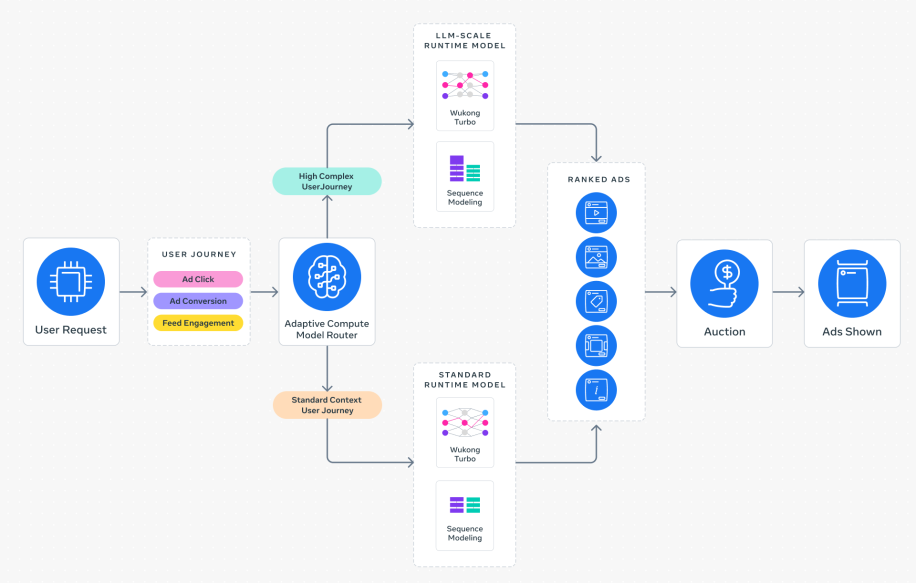
Meta says the system relies on large-scale processing similar to what it uses for AI models. This means the platform can handle complex calculations for millions of users without slowing down ad delivery.
Running a model at this scale in real time required engineering changes. For example, user profiling shifted from per-ad to per-request, which Meta says removes a substantial volume of redundant computation. This means instead of analyzing a user separately for every single ad, Instagram now looks at the user once per scroll (per request). That way, it doesn’t repeat the same thinking over and over.
What Meta Reports From the Launch
Meta reported that the Adaptive Ranking Model has been live on Instagram since the fourth quarter of 2025. In that time, targeted ads using the system have seen a 3% increase in conversions and a 5% increase in click-through rates. These figures come from Meta's engineering blog and have not been independently verified. Meta has not published advertiser-level data on campaign ROAS, CPA, or impression delivery at different spend tiers.
However, the company claims that the improved ad targeting is the result of processing more user signals and using advanced intelligence to prioritize ads that match user behavior. Meta also noted that it is continuing to explore ways to keep ad models fresh and relevant through improved engagement signal processing.
What this means for advertisers
For brands and marketers, the update indicates that Instagram ads may now reach users more effectively, with better alignment to their interests and behaviors. Advertisers may see differences in performance depending on how well their campaigns match the engagement signals the system prioritizes. The Adaptive Ranking Model could affect ad planning, targeting strategies, and campaign optimization on the platform.
Competitive Context
Google's Performance Max uses large AI models to optimise ad delivery and predict conversion probability in real time. TikTok's Smart+ automates targeting and creative decisions at comparable scale. Both operate with similar architectural goals, though neither has disclosed equivalent engineering detail about their ad ranking infrastructure publicly.
Recap
What is Meta's Adaptive Ranking Model?

Meta's Adaptive Ranking Model is an ad ranking system deployed on Instagram that computes user preference signals once per page load, then scores all ad candidates against that profile simultaneously. Previously, the system ran a separate user analysis for each ad candidate. The model operates at trillion-parameter scale and maintains sub-100ms latency through distributed GPU architecture and selective precision reduction (FP8 format).
What results does Meta report from the Adaptive Ranking Model?
According to Meta's engineering blog, the system delivered a 3% increase in ad conversions and a 5% rise in click-through rates for targeted users on Instagram since its Q4 2025 launch. Meta also reports a 35% Model FLOPs Utilization rate across multiple hardware types and model updates deployable in under 10 minutes. Meta has not published independent verification of these figures.
How does Meta's ad ranking approach compare to Google's and TikTok's?
Google's Performance Max and TikTok's Smart+ both use large AI models to optimise targeting and delivery at scale. What distinguishes Meta's announcement is the level of technical transparency: the engineering blog post includes hardware configurations, latency benchmarks, model size comparisons, and specific performance metrics, a level of detail neither Google nor TikTok has publicly disclosed about their ad ranking architecture.