








Meta has launched 'AI Mode,' an AI-powered search feature, to Facebook that answers search questions using public posts from across its apps rather than a ranked list of links. The feature sits inside Facebook as a search tab and draws on Meta AI to generate responses.
AI Mode changes how Facebook handles search. Instead of returning a conventional set of links or posts, it produces a synthesized answer built from what people are saying publicly across Meta's apps.
According to Meta, AI Mode uses Meta AI to provide answers from queries pulled from content across apps like Groups and Reels.
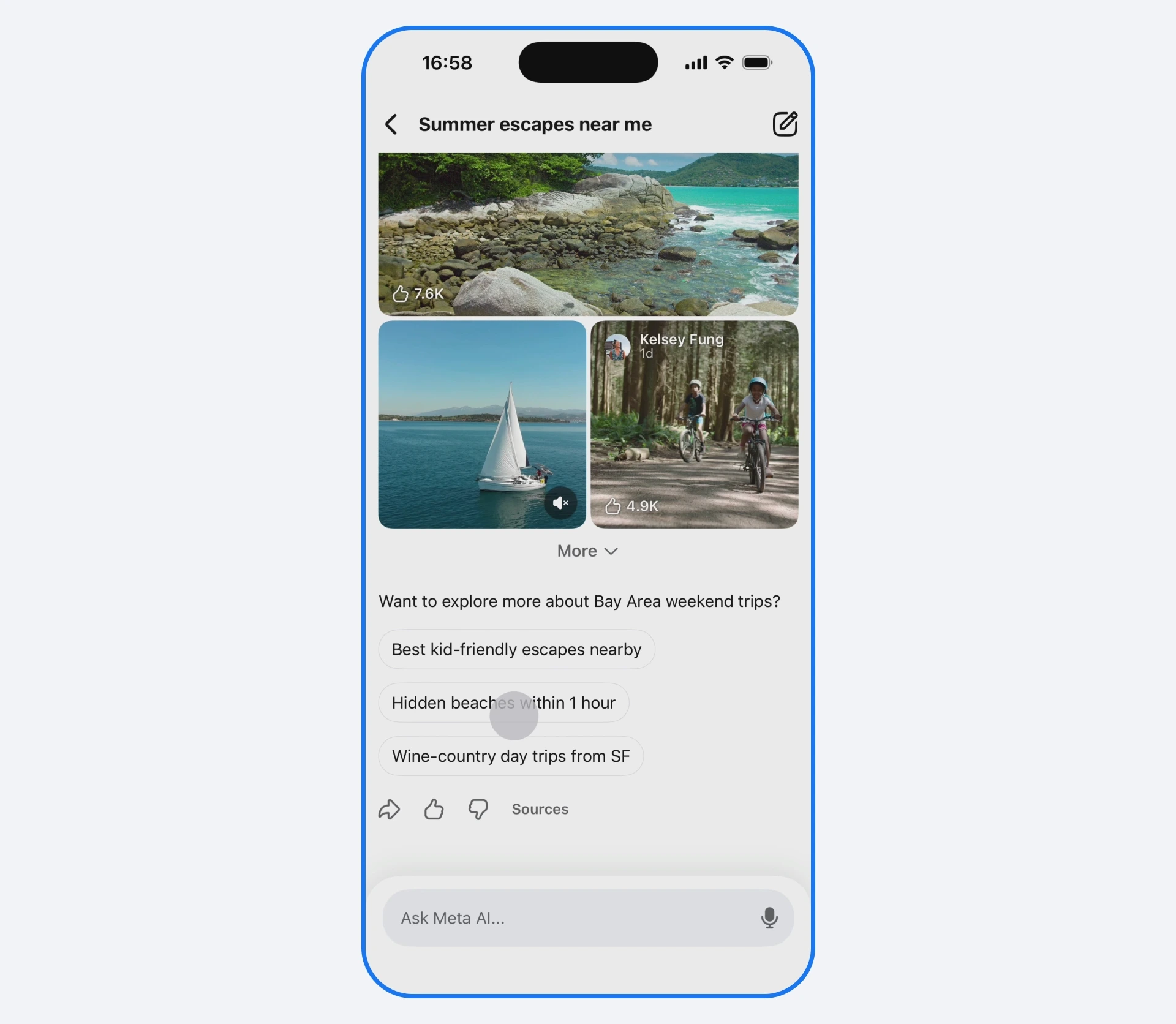
The update marks a significant change in how information is surfaced on Facebook. Traditionally, Facebook Search returned a list of posts, pages, groups, people, or marketplace listings. AI Mode instead generates a summarized response, similar to the way AI search products from Google, OpenAI, and Perplexity present information.
How Facebook’s AI Mode Works
AI Mode is designed to answer questions using publicly shared content across its apps. Instead of typing a keyword and scrolling through results, users can ask complete questions. The AI then generates a response by analyzing relevant public discussions and content.
The feature operates in two ways. It surfaces answers passively as users explore their Feed, and it responds actively when someone searches for something specific. In both cases, Meta AI assembles a response from public community posts instead of pointing users to a list of pages.
The system runs on Muse Spark, which Meta describes as Meta Superintelligence Labs' first model. In April, Meta introduced Muse Spark as the model it plans to thread through its consumer surfaces, and AI Mode is one of its first search-facing applications inside Facebook.
AI Mode appears alongside Facebook’s existing search options rather than replacing them. Users can still access traditional search experiences when needed.
Why the Source Matters
The distinction that sets AI Mode apart from a general answer engine is where it looks. Standalone tools such as ChatGPT and Perplexity synthesize answers from the open web. Meta is keeping its retrieval inside its own social graph, drawing only on public posts within its apps. That turns the content people share in Groups and Reels into the raw material the system cites.
For marketers, that changes where discovery can happen. If Facebook begins answering questions with content from communities rather than web links, what gets posted publicly in Groups and Reels becomes a factor in whether a brand or topic surfaces inside the app. It points toward a version of search optimization aimed at social content rather than indexed web pages.
Marketers tracking how brands advertise across Meta’s apps can search any brand’s live ads in seconds.
Competitive Context
In-app AI search has become a common direction across consumer platforms. Google rolled out its own AI Mode to all U.S. users last year and has since made it a central part of Search. OpenAI’s ChatGPT search provides conversational answers with web sources. Perplexity has built its product around AI-generated responses to search queries.
Snap has also moved to embed Perplexity's answer engine inside Snapchat, and YouTube has been testing an "Ask YouTube" search experience of its own. Meta is now bringing a similar approach directly into Facebook.
What separates Meta's approach is the source. While rivals point AI search at the open web or license an outside engine, Meta is building its own and grounding it in community content. That positions Facebook's social graph as a search asset rather than a feed to be ranked.
Alongside AI Mode, Meta introduced AI editing tools, including collage cutout templates, stylized video transitions, and photo presets that change clothing, hair, and accessories. Meta says the camera roll sharing suggestions tied to those tools remain opt-in and can be turned off at any time.
Recap
What is AI Mode on Facebook?

AI Mode is a search feature that uses Meta AI to answer questions with information drawn from public posts across Meta's apps, such as Groups and Reels, rather than returning a list of links.
How does Facebook's AI Mode work?
It works both passively, as users explore their Feed, and actively, when they search for something specific. Meta AI, powered by the Muse Spark model, synthesizes public community posts into a conversational answer.
What does AI Mode mean for marketers?
Because answers are sourced from public posts in Groups and Reels rather than the open web, content shared in Meta's communities could become the material the AI surfaces, making public social posting a factor in visibility inside Facebook.