





.jpg)




When Meta introduced Muse Spark in April, attention largely focused on its technical positioning as a multimodal AI system built by Meta Superintelligence Labs and designed to power what the company calls “personal superintelligence.”
However, the model is not just another chatbot. Meta says Muse Spark can process multiple types of inputs, including text and images, and coordinate multiple AI agents to complete complex tasks. That means a user can ask a question, upload a photo, and receive a response that combines both types of information.
What is Meta’s Muse Spark?
Muse Spark is a new multimodal AI model developed by Meta as part of its Superintelligence Labs division. It is the first model in what Meta describes as the “Muse” family of systems and represents a shift in how the company is building and deploying artificial intelligence across its products.
The company frames Muse Spark as AI systems designed to assist users more deeply across everyday tasks, rather than simply responding to isolated prompts. Unlike earlier Meta AI models such as Llama, Muse Spark is positioned as a more tightly integrated system built specifically for product deployment inside Meta’s ecosystem. It is designed to operate across both text and image inputs, making it a multimodal model capable of understanding and responding to different types of user queries, including visual content.

According to Meta, Muse Spark can also coordinate multiple AI agents to complete complex tasks. Instead of generating a single response in a linear way, the system can break down a request into smaller components, assign them to different “sub-agents,” and then combine the outputs into a unified answer.
Muse Spark is being rolled out in the Meta AI app and web experience in the U.S, with broader integration planned across Instagram, Facebook, WhatsApp, Messenger and Meta’s smart glasses. Meta says Muse Spark is part of a longer-term roadmap toward more capable AI systems that can handle reasoning, visual understanding, and task execution within its consumer platforms. This marks a move away from standalone AI tools toward embedded systems that operate directly inside Meta’s apps and services.
The company introduced two operating modes inside its AI interface: “Instant” for simple queries and “Thinking” for more complex, multi-step requests. According to the company, Muse Spark can also split a single task into smaller sub-tasks handled by different AI agents and then combine the results into one response.
While this framing is technical, the commercial implications are more direct. If AI systems become the primary interface for discovery and decision-making, they could also become central to how products are found, compared, and purchased inside Meta’s ecosystem.
What Muse Spark Changes About Shopping Behavior
Muse Spark points to a shift in how users interact with shopping-related queries inside Meta’s apps. Instead of browsing feeds or relying on search results, users may increasingly use conversational prompts to explore products and services.
For example, a user could ask Meta AI for outfit suggestions for an event, compare skincare products, or request home decor ideas rather than scrolling through posts or ads. Because Muse Spark is multimodal, these interactions can include both text and image inputs, allowing users to upload photos and receive product-related guidance.

This aligns with a broader industry trend toward conversational and assisted commerce. Research from firms such as McKinsey has shown that digital commerce journeys are increasingly fragmented, with consumers using multiple touchpoints before purchasing. AI systems compress those steps by combining discovery, evaluation, and recommendation into a single interface.
That shift is already visible across major tech platforms.
At Google, AI Mode in Search and the Gemini app now allow users to describe products in natural language and receive structured shopping results that include images, reviews, pricing, and comparisons in a single view. In some cases, the system can even track prices or check inventory across retailers before a purchase decision is made.
Similarly, OpenAI has introduced shopping experiences inside ChatGPT where users can refine product requests conversationally, compare options side-by-side, and receive curated recommendations without navigating traditional ecommerce pages. In these flows, product discovery and evaluation happen inside the chat interface rather than across multiple websites or search results. While still evolving, these experiences reflect a wider move toward AI-assisted decision-making in commerce journeys.
Importantly, early signals from Meta’s broader ecosystem suggest that AI is already influencing both user engagement and ad performance at scale. In its most recent earnings disclosures, Meta reported that its AI systems are contributing to measurable improvements in ad efficiency, including conversion rate gains across key advertising formats. The company also highlighted continued growth in Meta AI usage following the rollout of its latest AI capabilities, alongside stronger engagement across its apps.
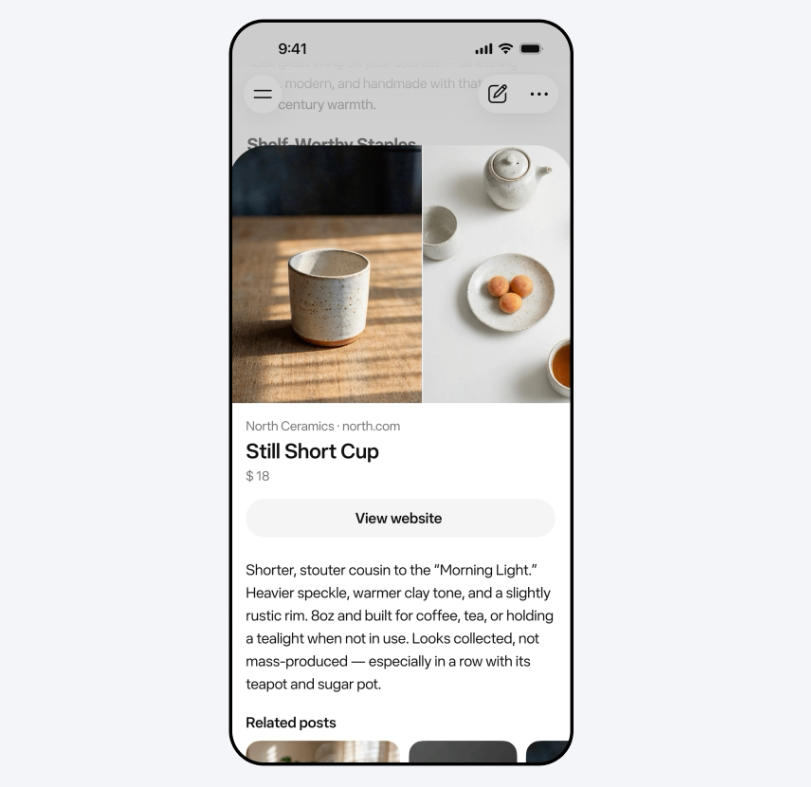
Across these systems, the key change is structural. Instead of users moving from search → listings → reviews → product pages, AI systems act as a consolidation layer. They interpret intent, retrieve relevant products, compare options, and present a shortlist that reduces the need for multiple browsing steps.
However, Meta’s approach differs in one key way. Muse Spark is embedded directly into platforms where billions of users already spend time.
Merchant Implications Become the Central Shift
The most immediate impact of Muse Spark may not be on consumers, but on merchants. Today, many brands optimize for feed visibility, ad performance, and search-based discovery. In an AI-mediated environment, those signals shift toward structured product data and machine-readable content.
Retailers and ecommerce brands will likely need to place greater emphasis on product feeds, catalog accuracy, and structured metadata. If Muse Spark is responsible for generating recommendations, it will depend heavily on how well product information is organized and maintained.
This creates an angle that is often described as “AI SEO,” where visibility is influenced not by traditional search rankings or ad placement, but by how effectively AI systems can interpret and retrieve product data. This means that attributes such as pricing accuracy, descriptions, inventory status, and product categorization may directly influence whether a product is recommended.
Imagery also becomes more important. Because Muse Spark supports image-based inputs and outputs, product visuals may play a role in how items are interpreted and compared. Clean, consistent, and context-rich images could improve how products are surfaced in AI-generated recommendations.
For instance, a user could upload a photo of a shirt, a chair, or a pair of shoes and ask the system to find similar options, compare alternatives, or suggest where to buy them. In that workflow, the AI is not only reading product descriptions but also interpreting visual features such as color, shape, style, and context.
This type of interaction mirrors broader developments in multimodal AI systems, where visual understanding is becoming central to product discovery. This reduces reliance on keyword-based search and increases the importance of how products are visually represented across merchant catalogs.
In that context, clean, consistent, and context-rich product imagery becomes more than a branding consideration. It becomes a ranking and interpretation signal. Products with clear backgrounds, multiple angles, and lifestyle context are more likely to be accurately recognized and matched in AI-driven recommendation systems, compared to low-quality or inconsistent visuals.
Over time, this could push merchants toward more structured visual standards across catalogs, especially as AI systems increasingly rely on images not just to display products, but to understand them.
Inventory accuracy is another operational factor. If AI systems recommend unavailable or outdated products, user trust in the system could weaken. As a result, real-time catalog synchronization may become more critical than in traditional feed-based advertising.
This shift also increases platform dependence. If product discovery begins to move from feeds and search engines into AI interfaces controlled by Meta, merchants may have less direct control over how and where customers encounter their products.
According to retail media projections from eMarketer, global retail media spending has been growing rapidly as platforms integrate commerce signals into advertising systems. Muse Spark extends this trend further by shifting product discovery from traditional feeds and search surfaces into the AI interface itself.
Advertising Implications: From Targeting to Recommendation Systems
Muse Spark also has implications for advertising models inside Meta’s ecosystem. Historically, Meta’s ad business has relied on targeting and auction-based delivery across its apps. That model is built on showing ads within feeds, stories, and search surfaces.
An AI-driven interface introduces a different dynamic. Instead of users passively receiving ads, they may actively ask for recommendations. This creates the possibility that advertising shifts from impression-based delivery to recommendation-based influence.
While Meta has not publicly detailed monetization models for Muse Spark, the structure of the system suggests future opportunities for sponsored placements or integrated product suggestions. Any such evolution would likely build on Meta’s existing advertising infrastructure, which already spans large-scale commerce and catalog-based ad formats.
This would not be unfamiliar territory for Meta, which has increasingly positioned itself as a commerce infrastructure provider rather than just a social advertising platform.
However, the introduction of AI-mediated recommendations could also change how performance is measured. Instead of clicks and impressions, engagement may increasingly be tied to whether a product is selected or recommended within an AI conversation.
Creator Content as a Commercial Input
Another implication of Muse Spark is the role of creator and user-generated content in shaping recommendations. Meta has long relied on engagement signals across its platforms to rank and distribute content. In an AI-driven system, those signals could also influence product recommendations.
If Muse Spark draws from content circulating across Instagram and Facebook, then creator posts, reviews, and community discussions may indirectly shape which products are surfaced in shopping-related queries.
Creator content may become part of the “input layer” for product recommendations. If a user asks Meta AI for outfit ideas for instance, the system may draw on fashion-related posts that have high engagement, strong interaction patterns, or consistent thematic relevance across creators. A viral styling video or widely saved product review could increase the likelihood that a similar product is suggested in an AI-generated response.
This effectively turns social content into a commercial input, where influence is not limited to visibility in feeds but extends into AI-generated recommendations.
WhatsApp and Conversational Commerce
The rollout of Muse Spark into WhatsApp could introduce a different commerce context: messaging-based shopping.
WhatsApp is already widely used by businesses for customer communication in many markets. Integrating AI into this environment could enable users to ask product-related questions directly within chat interfaces, receive recommendations, and compare options without leaving the conversation.
This extends the concept of conversational commerce, where discovery and interaction occur within messaging platforms rather than traditional storefronts or feeds.
Risks and Open Questions
Despite its potential implications, Muse Spark is still in early stages of rollout, and several questions remain.
One is reliability. AI-generated recommendations depend on the quality and completeness of underlying data. If product information is inaccurate or inconsistent, recommendations may not reflect real-world availability or suitability.
Another question is trust. As AI systems become more involved in product discovery, users will need to rely on their judgment of whether recommendations are neutral or influenced by commercial incentives.
There is also the issue of traffic distribution. If users receive answers and recommendations directly inside Meta’s AI interface, some merchants may see reduced direct visits to their websites, shifting value further into platform-controlled environments.
Finally, competition remains a factor. Amazon continues to strengthen AI-assisted shopping within its marketplace, while Google is integrating AI into search-based shopping journeys. Muse Spark places Meta more directly into this evolving competition for product discovery.
Conclusion
Muse Spark signals a broader shift in how Meta is positioning itself within digital commerce. While presented as an AI model upgrade, its deeper implication lies in how it may reshape product discovery inside Meta’s ecosystem.
If AI becomes a primary interface for shopping-related decisions, the structure of visibility changes. Product data, content signals, and catalog integrity may become as important as advertising spend in determining what users see and choose.
In that sense, Muse Spark is not just a model release. It is a step toward an environment where shopping is increasingly mediated by AI systems operating inside the platforms where discovery already happens.
Recap
What is Muse Spark changing in shopping inside Meta’s apps?

Muse Spark shifts shopping from scrolling feeds and search-based browsing to AI conversations where users can describe what they want or upload images to find products.
How does Muse Spark handle product discovery?
The system uses multimodal inputs like text and images, then processes requests using multiple AI agents that break down queries and return combined recommendations.
What does this mean for advertisers and brands?
Product visibility becomes more dependent on structured product data, catalog accuracy, and image quality rather than only ad placement in feeds or search results.

 Free tool · Meta Ad Library