









Search behavior is changing, and short-form video platforms are now part of how many people find information online. A new report from Adobe shows that nearly half of U.S. consumers now use TikTok as a search engine. According to the study, 49% of respondents said they used TikTok for search in 2026. That is up from 41% in Adobe’s 2024 survey. The report describes this as a 19.5% increase in adoption over two years.

This growth aligns with a broader pattern in digital behavior. Short-form video has become a dominant format across platforms, driven by mobile usage, fast consumption habits, and algorithm-driven feeds. Industry conversations have repeatedly pointed to TikTok’s growing role in discovery, with even traditional search players acknowledging that video content now influences search journeys.
Adobe surveyed more than 800 consumers and 200 small business owners across the U.S. The goal was to understand how people use emerging platforms, including TikTok and AI-powered tools, to search for information online. The report also examined how businesses are adjusting their marketing strategies in response to these changes.
How TikTok fits into the wider search environment
Even with rising adoption, TikTok is not replacing traditional search engines. According to the same report, Google remains the most trusted information source, selected by 85% of respondents. Other platforms also play roles in discovery. Reddit was selected by 29%, and ChatGPT by 26%. TikTok ranked fifth at 16%, behind YouTube, which stood at 24%.
.jpg)
This comparison shows something important. Consumers are not switching platforms entirely. Instead, they are diversifying where they search. Video platforms, community forums, AI tools, and traditional engines now operate together in the discovery process. That means brand visibility strategies may need to account for multiple entry points rather than relying on one dominant channel.
Why consumers use TikTok as a search tool
The report goes beyond adoption numbers and looks at behavior. While traditional search engines remain widely used, the study highlights specific reasons why consumers choose TikTok instead. According to Adobe, consumers said they turn to TikTok instead of traditional search engines mainly because of the short-form video format. 26% selected this reason. Storytelling followed at 21%, and interactive experiences at 17%.
That pattern is important. Traditional search engines are built around text-based results. Users type a query and scan links. TikTok works differently. Content appears as full-screen videos that respond to intent with visual demonstrations, voice, and context in one place. That reduces the need to move between pages to understand an answer.
The preference for video tutorials, selected by 61% of respondents, reinforces this behavior. When someone searches for how to cook a recipe, apply a product, or compare options, a short video can show the outcome directly. That aligns with how people consume content on mobile devices, where attention spans are short and visual information is easier to process.
Product reviews at 45% and personal stories at 41% also signal trust patterns. Instead of relying only on brand descriptions, users appear to look for peer experiences. Influencer recommendations at 33% further show that creators are part of the search journey. This does not replace search intent. It changes the format in which intent is satisfied.
This shift also changes the definition of search visibility. On traditional engines, visibility depends on ranking in text results. On TikTok, visibility depends on appearing within algorithm-driven video feeds that match user queries. That difference affects content structure, keyword usage in captions, and creative strategy.
The generational data adds another angle. 21% of Gen Z respondents said personalized content was a key reason for using TikTok for search, compared to 14% overall. This suggests that recommendation algorithms are shaping discovery behavior, particularly among younger audiences. Instead of actively filtering results, users are increasingly relying on platform-driven suggestions.
This does not mean consumers have stopped using other platforms. The same report shows that Google remains the most trusted source at 85%. Rather, it shows that search is expanding across formats. Video-first platforms are becoming a complementary entry point, especially for visual and experience-based queries.
What users search for and why it matters for brands
The report identifies several common search topics on TikTok. Recipes and beauty advice stand out as key areas. Restaurant recommendations are also highly searched.
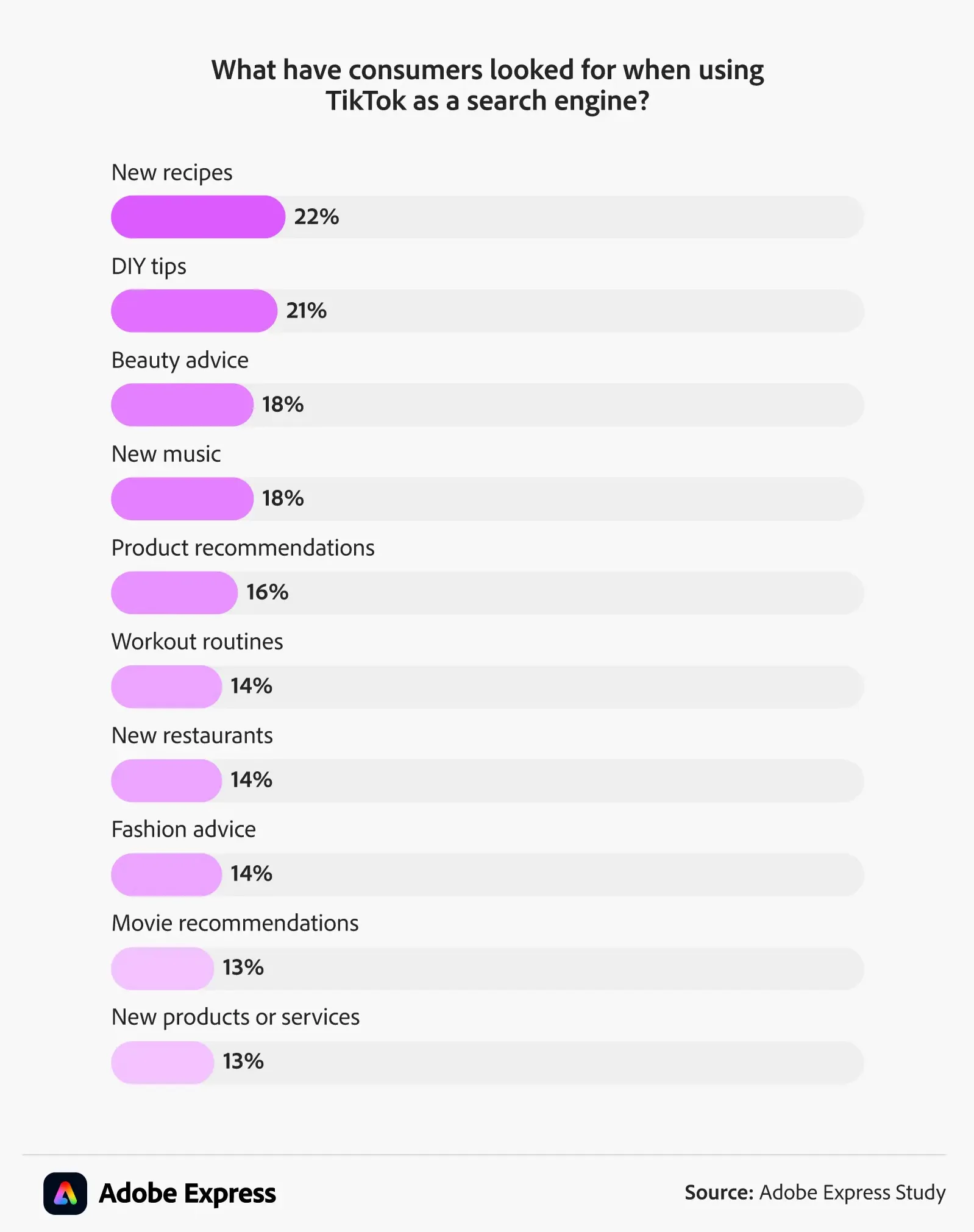
For brands in food, hospitality, beauty, and lifestyle categories, these trends suggest where audience attention is already active. TikTok appears to function as a complementary channel where users look for visual demonstrations and peer-driven recommendations.
How small businesses are adjusting
The report also surveyed small business owners. 58% said they have used TikTok for business promotion. 38% relied on TikTok influencers for sales or promotions in 2026, up from 25% in 2024. Business owners reported that their TikTok content performed better than traditional search results in areas such as product or service reviews at 29%, video tutorials at 28%, and personal stories at 24%.
On average, respondents allocated 16% of their marketing budget to TikTok content creation and 15% of their SEO budget toward TikTok search optimization. 37% plan to increase investment in TikTok affiliate marketing, while 31% plan to increase influencer marketing spending.
This suggests that businesses are treating TikTok not only as a social platform but also as part of their broader search and discovery strategy.
The rise in TikTok search behavior is happening amid regulatory scrutiny
As consumer search behavior evolves, it is also unfolding against a rapidly changing regulatory environment in the U.S. Earlier legislation would have effectively required TikTok’s China-based parent to divest or face a ban in the U.S. A superseding development emerged earlier this year when TikTok signed a deal to transfer much of its U.S. operations to a new joint venture with majority American oversight, including partners such as Oracle and Silver Lake; this arrangement was designed to address security concerns and keep the platform operational.
The deal includes local data storage and oversight of the recommendation algorithm under U.S. governance, while ByteDance retains a minority stake. These moves have essentially averted a full ban and allowed the app to remain available for American users into 2026 amid ongoing scrutiny about data privacy and algorithm control.
Even as policy debates around TikTok continue, the platform’s current legal status has enabled consumer usage and, according to the Adobe report, growing search adoption alongside other discovery channels.

Lucy Guest says the engagement shift reflects a deeper change in how people use TikTok.
“TikTok isn’t just a discovery engine anymore. It’s becoming a research tool. Users aren't commenting because they're not looking to socialise, they're looking to find answers. It's a continuation of the anti-brand movement in the comments (yes, that tactic might work in the short term but it's harming trust in your brand overall).
It's time to move away from short trend videos to longer content that delivers value and depth (and things viewers can actually take away). It's essential to optimise for search (that includes adding text on screen in-app, thinking strategically about captions, and subtitling your content).
We talk about social evolving all the time. This is the evolution. Attention hasn’t disappeared. Intent has increased. And strategies built for entertainment won’t win in a search-driven feed.”

Recap
How many U.S. consumers use TikTok as a search engine?

Nearly 49% of U.S. consumers used TikTok as a search engine in 2026, up from 41% in 2024, according to Adobe. That represents a 19.5% increase in adoption over two years across more than 800 surveyed consumers.
Why do people use TikTok instead of Google for search?
Consumers choose TikTok over traditional search engines primarily for short-form video content, cited by 26%, followed by storytelling at 21%. Video tutorials, product reviews, and peer experiences allow users to satisfy search intent visually without scanning multiple links.
Are small businesses investing in TikTok search optimization?
Yes, 58% of small business owners used TikTok for promotion in 2026, allocating 15% of SEO budgets to TikTok search optimization. Influencer use for sales rose from 25% in 2024 to 38% in 2026, signaling a strategic shift toward video-first discovery.