









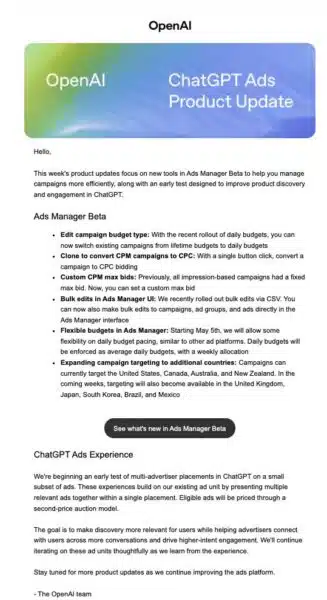
OpenAI is testing a way to show several advertisers inside a single sponsored unit in ChatGPT. The format groups relevant ads together instead of running one advertiser per placement, which expands the inventory available to buyers without increasing how many ads a user sees.
According to an update sent to advertisers, the multi-advertiser units are an early test limited to a small subset of ads. OpenAI's public documentation on ads in ChatGPT notes that a single sponsored unit may feature one or more items from one advertiser or from multiple advertisers, and that the ad most relevant to a user's chat is shown first.
How the New Placements Work
Eligible ads within a multi-advertiser unit are priced through a second-price auction, where the highest bidder wins and pays just above the next-highest bid. That mechanic already governs the ChatGPT ads auction, and extending it to units that hold more than one advertiser deepens each auction. The format runs inside the same auction system that sets how ChatGPT ads are priced and served.
The result is more competition per slot for OpenAI without a heavier ad load for users, since the additional advertisers share one placement rather than adding new ones. For advertisers, a single query can now surface more than one competitor at once, raising the value of both bid and relevance in winning the top position. Users continue to see a single labeled sponsored unit below a response.
The company began testing ChatGPT ads in February in its Free and Go plans. Paid tiers, including Plus, Pro, Business, Enterprise, and Edu, remain ad-free. An ad shows up as a single labeled sponsored unit below a response, visually separated from the answer, and only when the topic of a user's current chat matches an available advertiser.
OpenAI says ads run on separate systems from the chat model and do not shape the answers ChatGPT gives.
New Controls in Ads Manager
The same update adds several tools to the Ads Manager beta. Advertisers can switch existing campaigns from lifetime to daily budgets, clone a campaign in one click to convert it from CPM to CPC buying, set custom maximum CPM bids that were previously fixed, and make bulk edits directly in the interface rather than through CSV uploads.
OpenAI also began enforcing daily budgets as average daily budgets in May, spreading spend across a week in the way most ad platforms pace campaigns.
Targeting Expands to New Markets
Campaign targeting currently covers the U.S., Canada, Australia, and New Zealand. OpenAI says it will extend targeting in the coming weeks to the United Kingdom, Japan, South Korea, Brazil, and Mexico, widening the markets where advertisers can reach ChatGPT users.
Why It Matters
OpenAI is porting the mechanics of mature ad platforms into ChatGPT rather than inventing new ones. Self-serve management, CPC pricing, and a second-price auction all mirror the systems performance teams already run on Google and Meta, and multi-advertiser units add a familiar method for expanding inventory. Earlier this month the company brought ChatGPT ads live in the UK, and in May it shifted ChatGPT ads from CPM to CPC pricing.
Each of these moves makes the ChatGPT ad stack look more like the platforms buyers already know, which lowers the operational learning curve even as the channel stays small. For performance teams, the near-term value is less about scale than about learning where a channel that is neither search nor social will sit, especially since the audience stays structurally limited to free-tier users while paid ChatGPT plans remain ad-free.
Recap
What is OpenAI testing in ChatGPT ads?

OpenAI is testing multi-advertiser placements that group several relevant advertisers inside a single sponsored unit, instead of running one advertiser per placement. The format is currently an early test shown on a small subset of ads.
How are multi-advertiser placements priced?
Eligible advertisers in a unit compete in a second-price auction, where the highest bidder wins and pays just above the next-highest bid. OpenAI selects the ad most relevant to a user's chat to show first.
What does this change for advertisers?
The format expands the inventory advertisers can bid on without increasing how many ads users see, and puts more advertisers into each auction. That creates more competition per slot, which can influence pricing over time.