


.webp)




The U.S. digital video advertising market is moving into a new phase of scale and structure. According to a new IAB's 2026 Digital Video Ad Spend & Strategy Report, digital video ad spend will pass $80 billion in 2026, marking an 11% year-over-year increase and outpacing the broader advertising market by nearly 20%.
This growth is not happening evenly across platforms. The report shows that spending is being redistributed across social video environments like YouTube Shorts-style feeds, Instagram Reels-style placements, and TikTok-style short-form ecosystems, while connected TV continues to expand at a steadier pace inside streaming apps.
Across platforms such as YouTube, TikTok, and Instagram, advertisers are are increasingly buying algorithmically distributed attention, where delivery is shaped by platform recommendation systems rather than fixed placement schedules.
Social Video Overtakes CTV for the First Time
Social video is now expanding faster than CTV for the first time. This shows a shift in how video inventory is being consumed and bought across platforms. The IAB report estimates that social video will reach $31.9 billion in 2026, growing 13% year-over-year. At the same time, CTV advertising is projected at roughly $29.3 billion, growing 11%.
That gap marks a reversal: CTV has led digital video growth for several consecutive years. The format has long been seen as the more premium streaming environment for advertisers shifting away from linear TV. The shift suggests that creator-led platforms and short-form video ecosystems are capturing a larger share of incremental ad budgets.
Reels and TikTok are driving the shift. Meta’s Q1 earnings call reported that Facebook users spent 8% more time watching videos in the first quarter of 2026 compared to the previous quarter. On Instagram, Reels has become a core video surface alongside Stories and Feed, while on TikTok, advertisers are buying within creator-led content streams that rely heavily on recommendation algorithms.
Still, CTV continues expanding its inventory in parallel, with YouTube extending unskippable ad formats. In it’s Q1 report, YouTube claims it continues to see massive increase in viewership, and reported $10 billion in ad revenue, up 11% from previous year due to this growth. Netflix reported that ad-supported tiers now account for 45% of viewing hours in supported markets.
Digital Video Takes More Than 60% of TV and Video Ad Spend
Another key finding is that digital video will account for more than 60% of all TV and video ad spend for the first time. This places digital video as the dominant format across the broader TV and video category, not just within digital channels.
This changes how media planning is being structured. Instead of treating digital video as a complement to TV, it is becoming the main allocation channel, with CTV and social video competing within the same planning budget.
The report also notes that growth in digital video has slowed compared to the post-COVID surge in 2022. While spending is still increasing, the pace has cooled, which points to a more mature and competitive marketplace rather than rapid expansion.
Budget allocation patterns now show a clearer split between social video and CTV rather than a simple shift away from linear TV. Many advertisers are distributing spend across both formats depending on campaign goals, with social video often used for reach and engagement, while CTV is used for broader household-level exposure.
Agentic AI Enters the Buying Workflow
One of the more notable shifts in the report is the role of agentic artificial intelligence in digital video advertising workflows. According to the findings, two-thirds of media buyers say they are either live with, actively testing, or planning to implement agentic AI in their media buying workflows. That adoption rate suggests the technology is well past the pilot stage for most organizations.
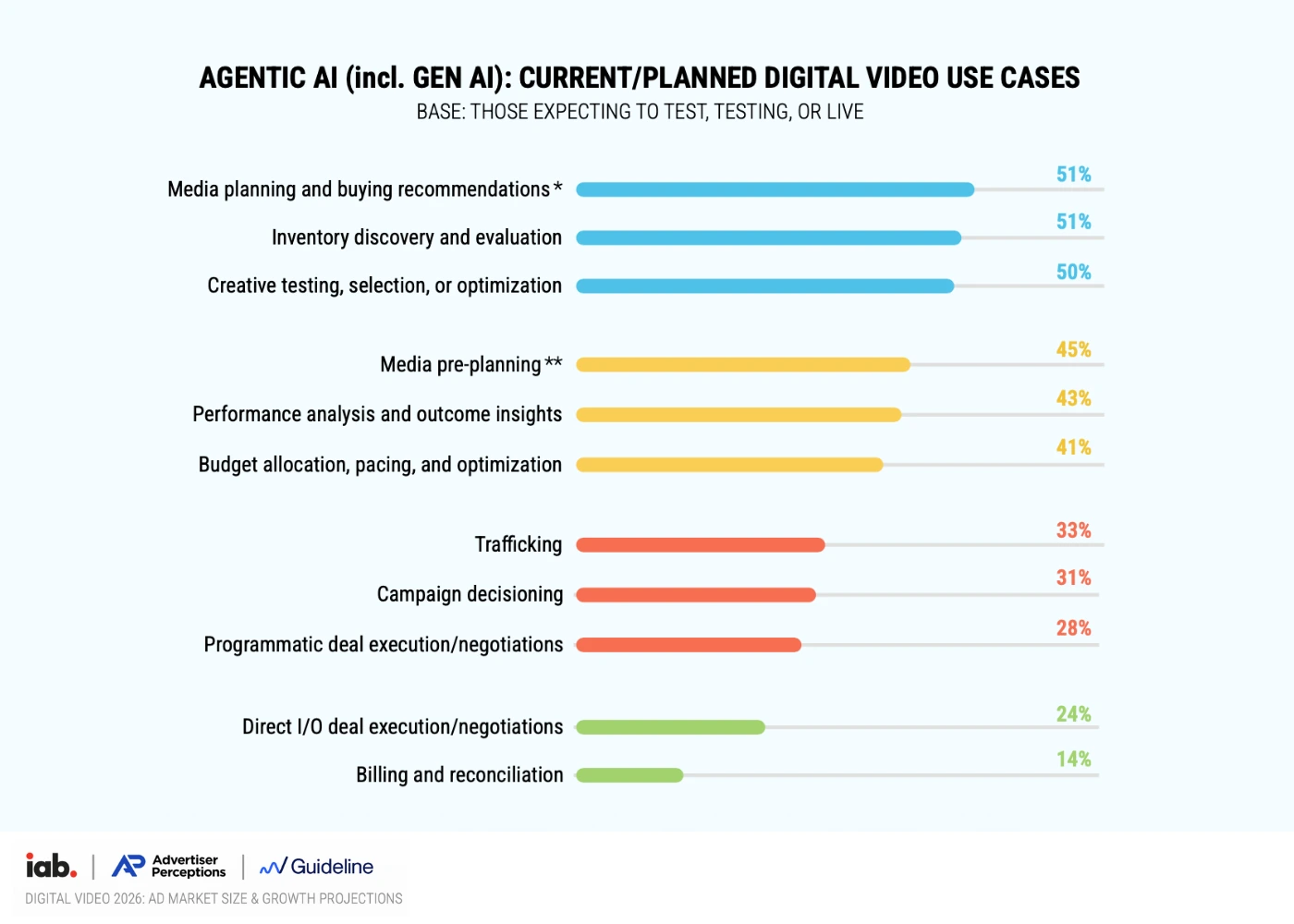
AI systems are moving beyond basic automation and into more decision-making roles in planning, targeting, and execution of video campaigns. On TikTok for example, advertisers are using AI-driven systems to test multiple creative variations of short-form ads, then reallocating spend toward versions that generate higher engagement or lower cost-per-action metrics.
Within Instagram Reels campaigns, AI systems are used to optimize audience targeting by continuously adjusting delivery based on engagement signals such as saves, shares, and view-through rates.
Targeting Now Outweighs Content Quality in Buying Decisions
The report also highlights a shift in what advertisers prioritize when buying TV and video inventory. Targeting has now overtaken content quality as the top criterion, rising 10 percentage points year-over-year.
This change is being driven mainly by small and mid-sized advertisers, which saw a 23-point increase in emphasis on targeting. The shift reflects a more performance-oriented approach to video buying, where audience precision and measurable outcomes are increasingly prioritized over the perceived quality of the surrounding content.
Advertisers are building campaigns around audience segments first, then selecting platforms or video environments afterward, using first-party data, lookalike modelling, and platform-native audience signals rather than relying on channel reputation alone.
What this Means for Advertisers
The IAB findings point to three clear movements in digital video advertising. Social video is accelerating faster than CTV, digital video is becoming the dominant share of TV and video spend, and agentic AI is moving into mainstream campaign operations.
The report also aligns with broader industry forecasts. eMarketer's independent projections places CTV spend at $37.95 billion with 14.5% growth. The alignment between the two reports reduces uncertainty for planning purposes.
The $80 billion milestone signals that digital video is no longer a complement to linear TV — it is the primary channel. Marketers allocating budgets for the second half of 2026 should account for social video's accelerating growth, particularly on platforms where short-form formats are driving outsized engagement.
For teams still evaluating agentic AI in their workflows, the two-thirds adoption figure indicates competitive pressure is building. Early adopters are gaining experience with automated targeting and optimization at a point when the learning curve remains manageable.
Recap
How big is U.S. digital video ad spend in 2026?

The IAB's 2026 Digital Video Ad Spend & Strategy Report projects U.S. digital video ad spend will surpass $80 billion, up 11% year-over-year. That is nearly 20% faster than the total ad market. For the first time, digital video will account for more than 60% of all TV and video ad spending.
Is social video or CTV bigger in digital video advertising?
By total projected volume, social video ($31.9 billion) and CTV ($29.3 billion) are close. But 2026 marks the first year social video has grown faster than CTV, at 13% versus 11%. The shift reflects advertiser investment in short-form vertical video on Instagram Reels, TikTok, and YouTube Shorts.
How are advertisers using agentic AI in digital video campaigns?
According to the IAB report, two in three digital video buyers are live (21%), testing (20%), or planning (25%) agentic AI use in video campaigns in 2026. Agentic AI is being applied across campaign setup, targeting, and optimization, not just creative generation.

 Free tool · Meta Ad Library