









Walmart has opened its first-party shopper audiences to every advertiser on Vibe, the self-serve connected TV (CTV) platform it bought this year. Advertisers can now pick segments built on what households buy at Walmart, online and in its stores, directly inside Vibe’s campaign builder, according to Walmart Connect’s announcement.
It is the first major product to come out of the deal. Walmart announced the acquisition in June and completed it in August, and Adweek reports that it paid $1.4 billion. The purchase followed Walmart’s $2.3 billion acquisition of TV maker Vizio in 2024.
The audience is what sets the launch apart. Walmart has spent this year widening where its shopper data can be bought, through Walmart DSP, its own demand-side platform, and partners such as Yahoo DSP. Vibe’s main users are small and mid-sized businesses, and Adweek reports that they need no special contract or seat to use the segments.
What Advertisers Can Target
Walmart Audiences appear in the In-Market and Interests section of any new or existing Vibe campaign, marked “by Walmart”. Vibe says they are available to all of its users.
The catalogue holds two kinds of segment, and an advertiser can combine both in one campaign. Personas group Walmart customers by life stage, lifestyle and shopping habits, such as new parents, recent movers, home gourmet cooks and upper-tier spenders, along with seasonal moments from Valentine’s Day to the winter holidays.
Category buyers group customers by what they buy or show signs of buying soon, organised by department. Advertisers can choose recent buyers, likely buyers or both. Vibe’s own product update says the segments run from broad ones such as dog supplies to narrow ones such as reptile food, quilting and diesel exhaust fluid. Adweek counts more than 3,300 segments in total, a figure neither company’s page states.
Each segment shows its estimated household count before it is added, and the reach estimate for the whole selection updates as segments go in or out. Vibe’s existing targeting, including synced customer lists and site-visitor audiences, works as before.
An Agent Builds the First List
Vibe has added an agent called Smart select that proposes the segment list. It reads the advertiser’s website, category, uploaded creatives, budget and schedule. It matches those inputs against the names of the Walmart segments, ranks them by relevance and checks the combined household count against the budget and flight dates.
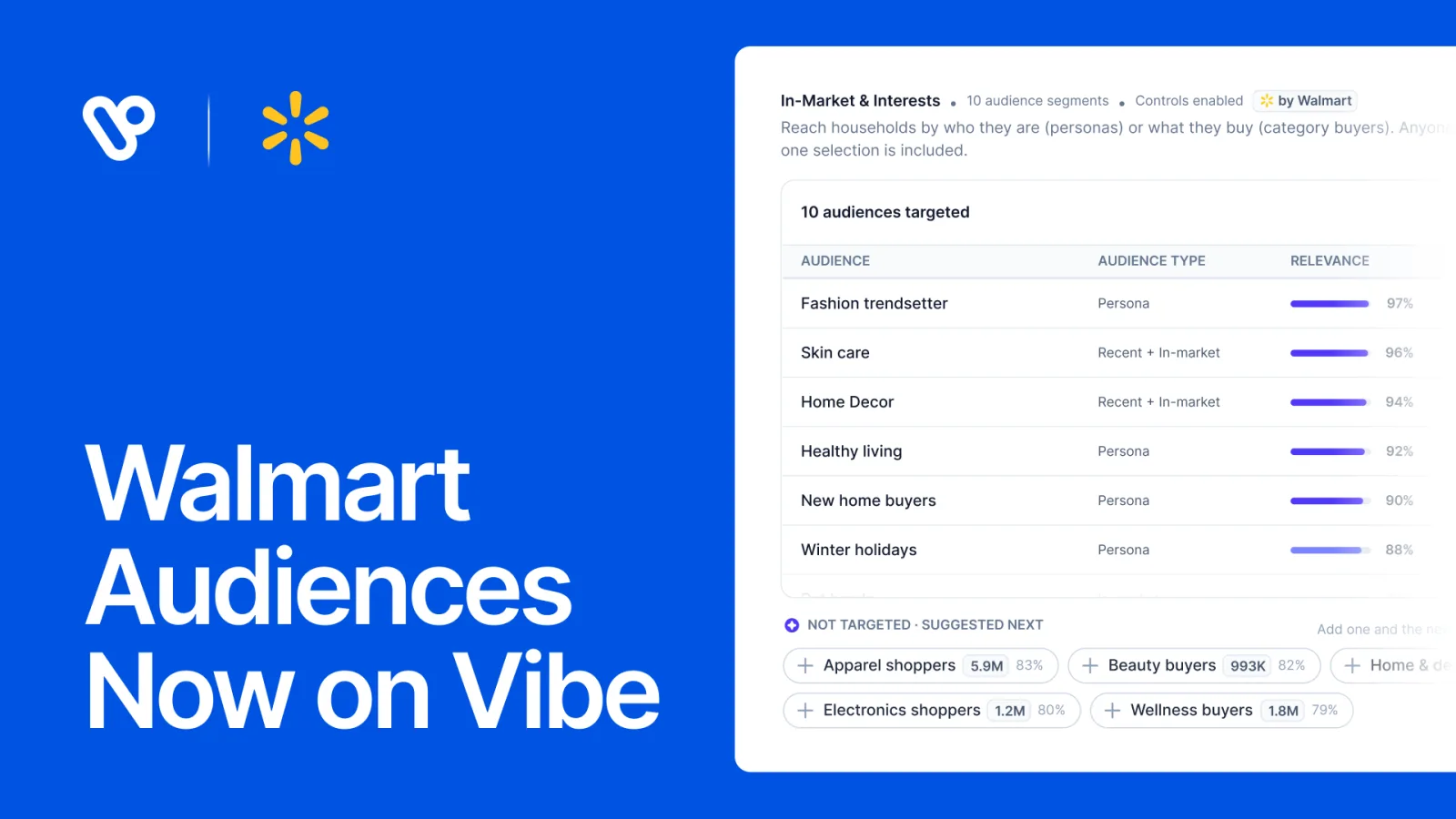
Vibe’s worked example is a skincare brand selling on its own site, with a $25,000 budget running from 1 October to 30 November. The agent picks four skincare category segments plus the women’s beauty and Big 6 Shopping Days personas, each scoring 84% relevance or higher and together covering 33.2 million households.
Vibe is plain about what that score means. It describes relevance as an estimate of how closely a segment matches the inputs, and says it is not a prediction of campaign performance. The agent’s picks also never go live on their own, because they land in the audience list for the advertiser to edit first.
Measurement Stays With Vibe
Results are read in Vibe’s existing tools, which include purchase-level attribution on an advertiser’s own site and incrementality testing. Adweek reports that advertisers buying through Vibe do not get Walmart Connect’s closed-loop measurement, which ties ads to sales at Walmart, and will keep using third-party providers such as Northbeam, Triple Whale and Haus.
That sets Vibe apart from Walmart’s other recent partnerships. In October, Walmart Connect brought its audiences and closed-loop measurement to Spotify through Walmart DSP, reporting attributed sales, new-to-brand buyers and return on ad spend. Ryan Mayward, general manager of Walmart Connect, told Adweek that the two companies plan to add measurement to Vibe later, calling the integration “the first step in a much larger CTV opportunity”.
The Second Platform to Make This Move
Walmart is following a path Pinterest took with tvScientific, a CTV performance platform. Pinterest agreed to buy tvScientific in December 2025, and in April it launched CTV ad placement that lets advertisers reach Pinterest audiences on third-party TV apps. In both cases a company with first-party data bought a performance-led CTV platform and made that data its first product there.
 Pinterest
 Walmart
The difference is the data. Pinterest sells signals of what people are planning, and Walmart sells a record of what households have bought. Vibe’s suggested first test is to duplicate a campaign that uses broad interest targeting, swap in a few matching Walmart category buyer segments, and run the two side by side.
Recap
What are Walmart Audiences on Vibe?

They are Walmart Connect’s first-party shopper segments, built on what customers buy online and in Walmart stores, now available to every advertiser in Vibe’s self-serve CTV platform.
How do advertisers use Walmart Audiences in Vibe?
Advertisers open In-Market and Interests in a campaign and choose personas or category buyer segments, either by hand or with Vibe’s Smart select agent, which ranks segments by relevance and checks household reach against the budget.
What changes for advertisers?
Small and mid-sized advertisers can target Walmart purchase data on TV screens without a special contract or seat, but they measure results in Vibe’s own tools and third-party providers rather than Walmart Connect’s closed-loop measurement.